Lissenung Island – Paradise Found

Christopher travels to Lissenung Island in Papua New Guinea for a dream dive experience
Have you ever dreamt about staying on a remote tropical island, being lulled to sleep by the gentle lap of the waves on the white sand beach, the wind softly rustling the leaves of the palm trees, as images of the day’s diving among spectacular coral and schools of fish float through your mind?
Dream no more. Lissenung Island, twenty minutes by boat south of Kavieng harbour is that paradise island. Owned by Austrian ex-engineer Dietmar Amon and his wife Ange, its seven rooms are ideally located for diving both the South Pacific Ocean sites to the north and the Bismarck Sea sites to the south, and around the numerous small islands that cover the area. The usual routine sees the dive boat leave after breakfast and return for lunch. Afternoon dives leave around 3 PM, and dusk dives to look for the impossibly colourful mandarinfish can be organised.
The aptly nudibranch-shaped island is nestled half-way between the jaws of western New Ireland, and has coral reef around two-thirds of its small shore. I say aptly named as although New Ireland has a deserved reputation for big schools of pelagics, from bumphead parrotfish to silvertip sharks, Dietmar is an ardent fan of the oceans’ smaller, slower occupants.
Nudibranchs, a sort of brightly coloured sea slug of which there are over 800 species, and cowries, marine molluscs, are amongst his favourite finds. Although they might sound like the underwater equivalent of spotting stationary trains, Dietmar has fascinating tales about their underwater feats. Who would have thought that one of the deadliest creatures in the ocean is the geographicus cone shell, also known as the cigarette snail, as smoking one last one is about all a human has time to do after being bitten by one.
We arrived for lunch, and as we strode ashore and up the short beach to be greeted by our hosts, it was impossible not to break into a grin. The only shoes we’d be wearing for a week were fins as the path from the restaurant to our chalet was velvety soft sand.
Straight after lunch we sorted our kit out, boarded the twin-hulled dive boat, and headed back to Kavieng harbour for an afternoon muck dive on an upturned Pete WW2 Japanese float plane, and around the wharf, where a decent number of the marine world’s weird and wonderful inhabitants such as ghost pipefish, nudibranchs and shrimps, octopus, and pipefish dwell.
The harbour tends to be a bit murky given its sandy bottom and protected nature, but the dives sites on the reefs between the islands were much clearer. The changing tides produce some strong currents that flush clear waters from the deep sea over the abundant reefs and through tiny passages. It is during those currents that the pelagics pitch up; Grey, blacktip, and whitetip reef sharks, tunas, mackerels, schools of jacks and barracudas are frequent visitors to the numerous dive sites to the north and the south.
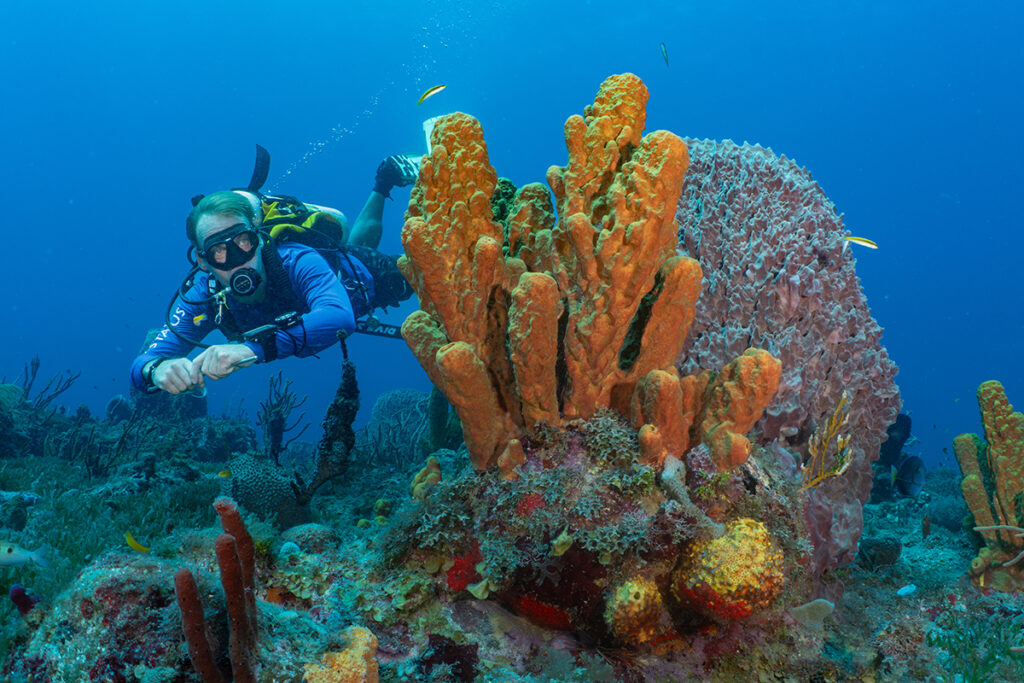
The following morning we headed south to Danny’s Bommy. Starting at 7m, it is connected to the island via a saddle down at 15 metres, and on the outside it plummets straight down into the inky blue depths. We dropped in and headed down to 30 metres where a school of twenty-odd, large humphead parrotfish were cruising. They didn’t stop, and I think the coral must’ve been very pleased. These 40-kilo fish look like they could do some serious grazing with their beaks (really teeth fused together) and, unlike most other parrotfish, are partial to live coral as well as the algae that live on them. Coming back up I spied a white-bonnet anemonefish, the eighth of the nine species that live in PNG waters that I had seen. Now only the panda or saddleback anemone fish was missing. We ended the dive among the schools of fusiliers adorned the top of the coral-covered bommie, gazing into the blue.
[wppa type=”slideonlyf” album=”19″ align=”center”][/wppa]After relaxing in the sun on the boat (there is plenty of shade, but I get plenty of that back home) with some fresh fruit, we headed over to Kavin II and its long wall for a spot of pygmy sea horse hunting on gorgonian fans. Nozaki, the resident instructor, soon gave me the underwater “look here, small stuff” sign, and sure enough, right where she was pointing, was a miniscule centimetre-long, knobbly pink seahorse. Amazing.
I snapped a few shots off before thinking that I had to be able to find it for myself before I could use the picture, otherwise it would be like getting someone to hunt trophies for you. I turned my head away and looked back. Gone. I knew what it looked like, I knew where it was to within a square metre, but, try as I might, I could not find it. I searched, my face inches from the fan, for several minutes, until I started to go cross-eyed and lose the ability to focus. Nozaki came back, waved her hand in front of the fan gently, and found it in under ten seconds, and left me to continue my challenge.
I tried the hand wave, more a flexing of the fingers than a regal Queen Liz special, and lo and behold something tiny was swaying before my squinting eyes, its tail curled around apiece of fan. I was a pygmy seahorse hunter and raised my camera and snapped away under the watchful eyes of a longnose hawkfish, whose presence I’d totally overlooked. So engrossed was I in my quest for one of PNG’s dive grails, I’d almost missed this photographer’s chalice. As I’d been down there for so long, it had got used to my presence and pouted for me until dive computer told me that it was time to ascend to shallower depths.
Closer to the surface my camera found little respite as Ange pointed out a leaf of seagrass that had legs and a pair of eyes. A superbly camouflaged halemeda crab was lurking on the wall. About 20 metres further along one of his cousins, the slightly more conspicuous but equally small orang-utan crab was trying to hide in a crack. After seventy minutes we were unsurprisingly low on air, low on battery, and pretty famished.
After lunch at the resort, a battery change, and a decent snooze, just before dusk we headed north to a destination known only as Nozaki’s Secret. It is listed on the dive site map, but not shown. Why the secrecy? Mandarinfish. These impossibly brightly coloured creatures attain six centimetres in length, and are nocturnal. Not surprising given how well they stand out in daylight. Odd as this may seem, it is part of their defensive system. One of the few scaleless fish species, they are protected by a toxic mucous and their Chinese lord’s robe motif is a good example of aposematic coloration – where toxic creatures warn potential predators of their inedibility through the use of bright colours.
Five metres below the surface, Nozaki set up two underwater torches on sticks to illuminate a head of finger coral and we settled in to watch the show. The males put on dancing displays to attract one of the numerous females. When a female was suitably impressed she would rub up against the male’s pelvic fin, the pair would rise up 50 centimetres from the coral head for 10 to 15 seconds, release a mixture of eggs and sperm, and then shoot back to the protection of the coral. Trying to get the camera to focus in the low light during one of these brief forays into the open proved to be quite a challenge, and we spent a good half an hour watching a succession of males dance and the subsequent mating.
Over the next four days we dived the best reefs to the north and the south, and enjoyed them all. Matrix has fantastic hard corals in the shallows and huge fan corals from 20m downwards make beautiful scenery. Drifting along, on the current the reef was a riot of vivid colours as anthias and butterfly fish danced around the corals. This is probably the most beautiful drift dive around Kavieng.
Peter’s Patch, at the south eastern tip of a large reef system in the Steffen Strait, is great for batfish and pelagics, with tuna and barracuda a-plenty. On the other end of the reef system lies Helmut’s Reef, and here we found leaf fish and white-bonnet anemonefish, one of the rarer of the nine species of anemonefish found in PNG.
But the best site in the area, in my opinion, is the amazing Albatross Passage. On an incoming tide this narrow passage between two islands is like fish soup. As water comes in from the deep and gets closer to a shelf nine metres below the surface it speeds up and draws in a myriad of fish life from the food chain. Schools of sardine-sized fusiliers and snappers looking for lunch brought by the upwelling waters attract dogtooth tunas and barracudas, which in turn attract grey reef, blacktip, whitetip and sometimes silvertip sharks. Eagle and devil rays are sometimes seen here, and hooking onto the top of the reef and watching the action over the top of the wall is a spectacular experience.
The wall itself is covered with big fan corals, black corals, soft branching coral, and sponges and this is the home for small creatures like nudibranchs, leaf fish, and scorpionfish. At around 30 metres there is a sandy shelf that does a good job of reflecting the light, and even when the current is pumping at the top, the deeper sections of the wall and the shelf are calm. On a foray to find more pygmy seahorses and long-nosed hawkfish, a large cuttlefish gave us a display of its ability to change colours. We dived this site three times, and would gladly go there every day.
Afternoon dives on the house reef that goes two-thirds of the way around the island are free, and much of the best stuff is in three metres of water, making it ideal for snorkelling too. It doesn’t take too much luck to get a glimpse of juvenile blacktip reef sharks around the far side of the island, but here I was interested in something a little more elusive. I had photographed eight of PNG’s nine anemonefish species, but was missing one. The panda or saddleback anemonefish. Wading into the water, past the seahorse lolling around like a seemingly listless drunk, I followed Dietmar’s directions to the mooring buoy, turned right, and swam over the sandy bottom for all of 30 seconds. Lo and behold, in a small anemone was my prize. And they weren’t alone. A couple of transparent anemone shrimp were out too, and kindly posed for me.
Several times a year, Lissenung’s twin-engined 26-foot Ozycat heads northwards to New Hanover on expeditions to explore virgin reefs, a Japanese two-man submarine, and Chapman’s reef and its resident giant groupers, staying in guesthouses on different islands depending on the itinerary. For Ange and Dietmar, this tiny island has become home, but for us, this was paradise.
Papua New Guinea travel: PNG is three hour’s flight time north of Australia, six hours from Singapore, and has weekly and twice weekly direct flights from a range of destinations like Manila, Cebu, Bali, Sydney, Cairns, Hong Kong and Tokyo. Within PNG, the best way (and often only) way to get around is by air either with Air Niugini or Airlines of PNG. Lissenung Island’s closest airport is Kavieng, and has daily flights from Port Moresby. Returns are around $400 USD.
Best of PNG put together tailor-made dive trips that can also take in the best Sing-Sings (cultural festivals) on the PNG calendar, trekking up Mt Wilhelm or the Kokoda Trail, and Sepik River expeditions. www.bestofpng.com