Three Wrecks, One Perfect Dive Day with Ghazala Adventure

Ghazala Adventure
Oh no – it’s already our penultimate dive day, but what a day it was. Where did the week go? Liveaboard trips are so incredibly packed with amazing dives and that constant DIVE, EAT, SLEEP rhythm that time just flies by. Maybe next time we should book for two weeks! 😉


Rosalie Moller
It had been a good few years since I’d last dived the Rosalie Moller – fourteen, to be precise. My memories of the dive weren’t the best. I remembered it as deep, dark, and surprisingly green for the Red Sea.
So, the night before the dive, I was in two minds about whether to go. Quite a few of my fellow divers had already decided to give it a miss as it’s considered more of a technical dive. However, I’ve never really been one to sit out a dive, so in for a penny… I set up my camera and headed down for the early morning briefing. Without a buddy, I planned to stick with one of our fantastic dive guides, Reda, although I still wondered whether I’d enjoy the experience.

As it turned out, I was very glad I decided to give this wreck another chance as the dive was utterly brilliant!
The Rosalie Moller is the sister ship of the Thistlegorm. She’s a 108-metre cargo ship that once transported coal. In 1941 she was doing exactly that, enroute to Alexandria. While moored at Safe Anchorage H and awaiting clearance to continue through the Suez Canal, tragedy struck. The same Heinkel bombers that had attacked the Thistlegorm returned just 48 hours later, on 8 October. A single bomb struck hold number three, causing catastrophic damage and sinking the vessel, with the loss of two crew members.


Today, the Rosalie rests on a sandy seabed at 55 metres off the west of Gubal Island. Her deck lies at around 30–35 metres, while the mast rises to about 18 metres.
For our dive, the guides had set two lines – one at the stern and one at the bow. Our plan was to descend the stern line and begin exploring the stern section of the wreck. From there we would pass the crew galley before moving along the starboard side toward holds three and four. In this area you can see the engineer’s accommodation and access the main galley, exiting on the port side in front of the funnel.

Next, we would explore inside the bridge and around the bow before ascending along the mast. A connecting line had also been attached between the bow and stern lines, allowing us to swim easily back to the liveaboard at the end of the dive.
Most of the original artefacts have long since been removed from the Rosalie, so don’t expect the same cargo-filled holds as the Thistlegorm. But what the wreck lacks in artefacts, it more than makes up for in atmosphere. The water was a little murkier than elsewhere on the trip, but the structure is now covered in stunning hard and soft corals.


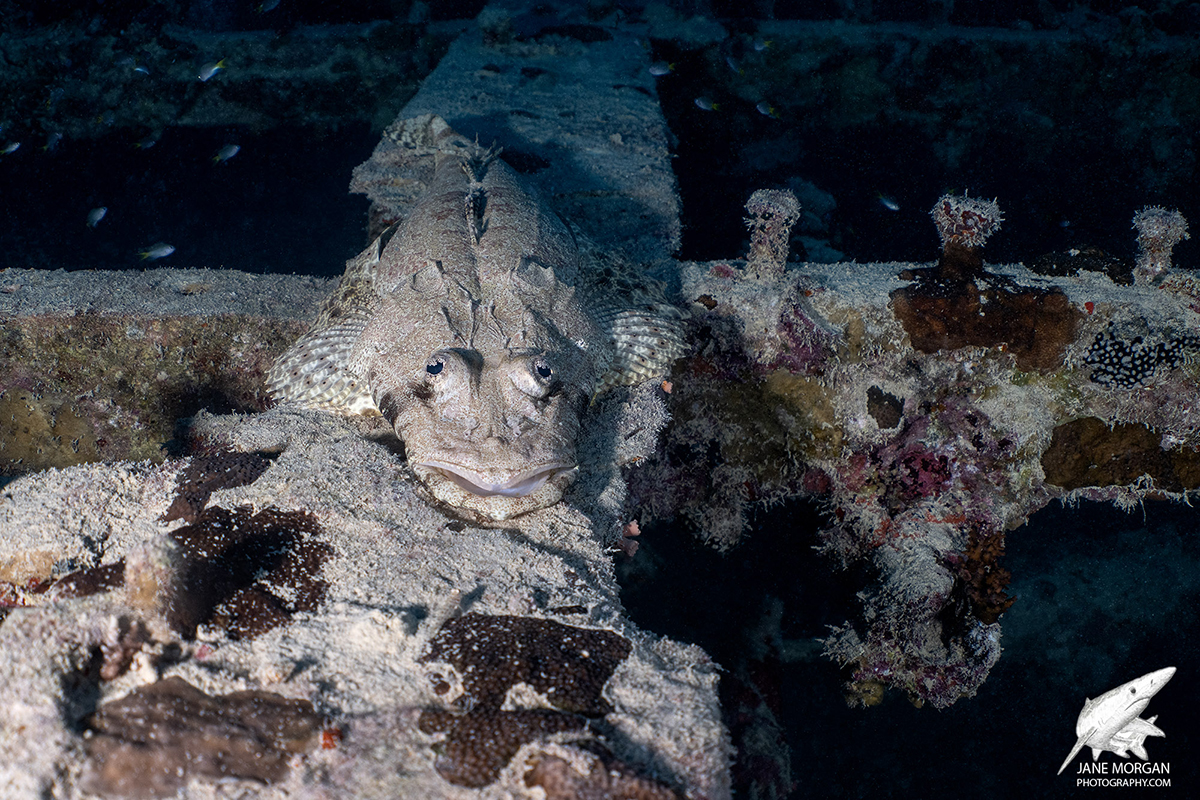
This artificial reef is teeming with marine life. Anemones, crocodile fish, and torpedo rays decorate the wreck, while shoals of glassfish, lionfish, and groupers hover around its structure. And if you glance out into the blue, you might even spot passing barracuda, trevally, or the occasional shark.
In the end, this was one dive I’ll be eternally grateful I got out of bed for.
Ulysses
Before lunch we moved back around to the eastern side of Gubal Island to moor up for our second dive of the day on the Ulysses. As the wreck lies to the north of the island, this would be a zodiac drop-off and pickup.

Our briefing began with the dive guides checking the current and explaining that we would likely need to make a negative entry. However, most of these instructions quickly went out of the window with the sudden arrival of an inquisitive pod of dolphins as the first two zodiacs approached the site. It’s not unusual to encounter dolphins in this area, and it’s always a special experience to see them around a wreck. The excitement on entry meant that quite a few of our fellow divers seemed to forget the rest of the briefing entirely, and honestly, who can blame them? 😉


The Ulysses is a 95-metre 19th-century British iron steamship that sank in August 1887 after striking the northern reef of Little Gubal. Today she rests on her port side in depths ranging from 5 to 28 metres, with the stern sitting at the deepest point.
This stern section is also the most intact part of the wreck, featuring a coral-encrusted propeller and rudder. If you take a moment to look closely at the seabed here, you’ll also spot tiny nudibranchs scattered among the sand.

From the stern, the wreck is easily penetrated through the iron deck supports, as the original wooden decking has long since rotted away. We swam upward along the wreck toward the mast, which now lies stretched out across the sand and is beautifully smothered in both hard and soft corals.
The funnel also rests on the sandy seabed. Although it’s no longer safe to swim through, it still provides some excellent photographic opportunities.


The broken bow section has gradually become part of the surrounding reef. Thanks to the age of the wreck, the entire area is now home to a myriad of marine life. My personal favourites are the ever-busy anemonefish and the vibrant sergeant majors darting around the shallows.
Chrisoula K
We certainly lucked out with the weather for our dive on the Chrisoula K. The sea was completely calm – no waves, no surge, just flat as a pancake. Normally boats have to moor in the channel and divers reach the wreck by zodiac, but on this occasion, we were able to moor directly over the bow. I have to say, there’s something pretty special about peering over the dive deck and seeing the wreck lying clearly below you in the water.

The Chrisoula K is one of four wrecks that met their fate on the infamous reefs of Abu Nuhas. Often referred to as the “Tile Wreck,” she was enroute to Saudi Arabia carrying a cargo of Italian tiles when a navigational error caused her to run aground on the reef in 1981.
Because the wreck lies so close to the reef edge, it is frequently battered by waves and swell, meaning the structure can look slightly different from one dive to the next. Thankfully, with the wonderfully calm conditions this wasn’t something we needed to worry about.


The 3,100-ton Greek freighter now rests between 3 and 26 metres, with the stern sitting at the deepest point. Our briefing was simple: descend the shot line directly below the boat and head toward the bridge before continuing to hold number two. Just off the wreck, out on the sand, lies a large eel garden, so we made a short detour to watch the eels swaying in the current before returning to the wreck.

From there we passed the funnel and companionway before continuing down toward the stern, where the propeller and rudder can still be seen. Our route then took us through hold number three, where we explored the workshop before exiting in front of hold two and following the wreck all the way back to the bow.
I’m pleased to say we executed the dive perfectly, although when you’re following Reda, it’s hard not to. Scattered throughout the holds are huge piles of tiles, many of which still clearly display the stamp “Made in Italy.”

Stay tuned because in the next instalment we will be exploring more of the Abu Nuhas wrecks.
Book your next diving adventure on Ghazala Adventure with Scuba Travel: www.scubatravel.com
Book your dive insurance with Dive Master Insurance: www.divemasterinsurance.com