Sharks and Ray course at Cocos Island onboard Sharkwater

 You’ve watched the shows on the Discovery Channel and National Geographic, now it’s time to learn from the legend, Dr. Hammerhead, the pioneer of shark research.
Dr. A Peter Klimley, who was the adjunct Professor in the Department of Wildlife, Fish, and Conservation Biology and Director of the Biotelemetry Laboratory at the University of California Davies, will offer a nine-day course onboard the Sharkwater, on May 14-24, 2022, on the biology of sharks and rays.
Dr. Klimley has published over 100 scientific articles, a popular book “Secret Life of Sharks” and reference book “The Biology of Sharks and Rays” during his long career while giving numerous lectures on this topic to undergraduate and graduate students. These lectures will be followed by SCUBA diving at this beautiful island, surrounded by warm, clear waters inhabited by many species of sharks. In addition to learning about the biology of sharks and rays, the participants will dive among the many whitetip reef sharks scattered among the rocks near the island as well schools of scalloped hammerhead sharks that surround the Alcyone Seamount off the coast of the island.
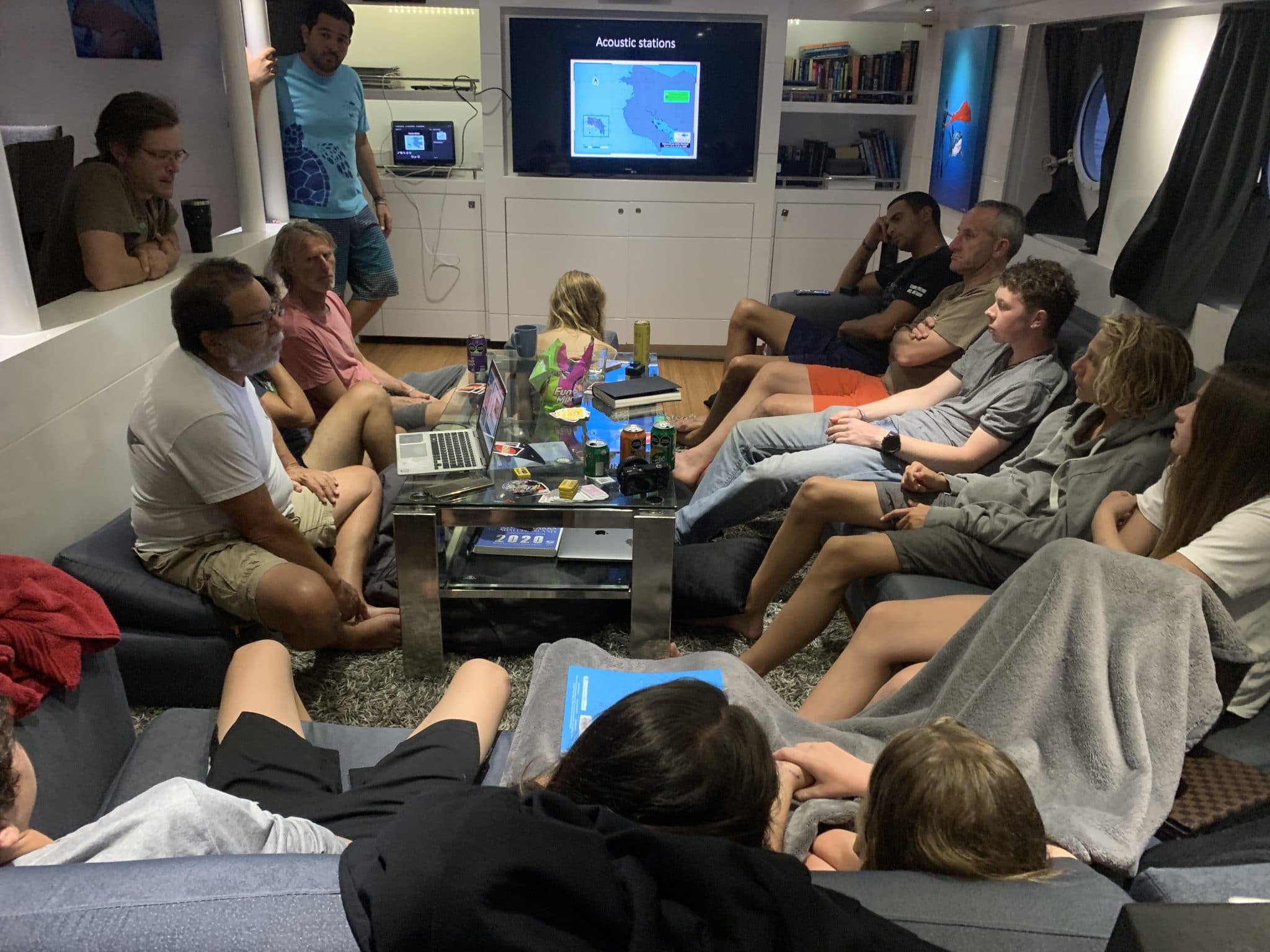
10-days, 9-nights, 7-days the Cocos Island. Two lectures will be given each day during transit; one lecture will be given in the spacious lounge with its large television screen during the morning of the days at the island. A provisional list of lecture subjects is given here:
- An introduction to the sharks and rays at Cocos, providing the identifying characteristics of each species with photos of each species with a little about the life history of each
- The evolution of sharks through geological time, including a discussion of the demise of the huge Megalodon shark that fed on the proto whales
- The anatomy of sharks and rays and their modes of swimming
- The physiology of the cold bodied reef sharks and warm bodied mackerel sharks
- Sharks acute olfactory and mechanoreceptive abilities using their lateral lines and inner ears
- Sharks use of vision and electroreception to capture prey and use of electroreception (magnetoreception) in guiding them while making nightly foraging trips and long-distance migrations
- Feeding mechanisms such as ambushing, pursuit, scavenging, and plankton feeding
- Shark rates of growth and longevity with one species, the sleeper shark, living to an age of 360 years
- Shark courtship, which involves the male biting the female, development with embryos feeding upon each other within the uterus, birth, and reproductive cycles
- Movement patterns, both local and long distance
- Interactions with humans and how to avoid a shark attack
- State fisheries, over-fishing, shark finning, and the creation marine reserves
- The participants of this course will leave with comprehensive understanding of the physiology, behavior, and ecology of elasmobranchs
The course will also be open to anyone in the general public interested in learning more about sharks.
Research activities will include tagging sharks, collecting tissue samples and servicing underwater receivers.
Course Dates: May 14-24, 2022
Cost: $6,000 plus $550 park fees
Limited to 10 participants.
Included: Shark and Ray course, course materials, diving, meals and drinks onboard Sharkwater
For more information and to sign up click here.