Serendipity

Serendipity means a “fortunate happenstance” or “pleasant surprise”. The New Oxford Dictionary of English defines serendipity as the occurrence and development of events by chance in a satisfactory or beneficial way, understanding the chance as any event that takes place in the absence of any obvious project.
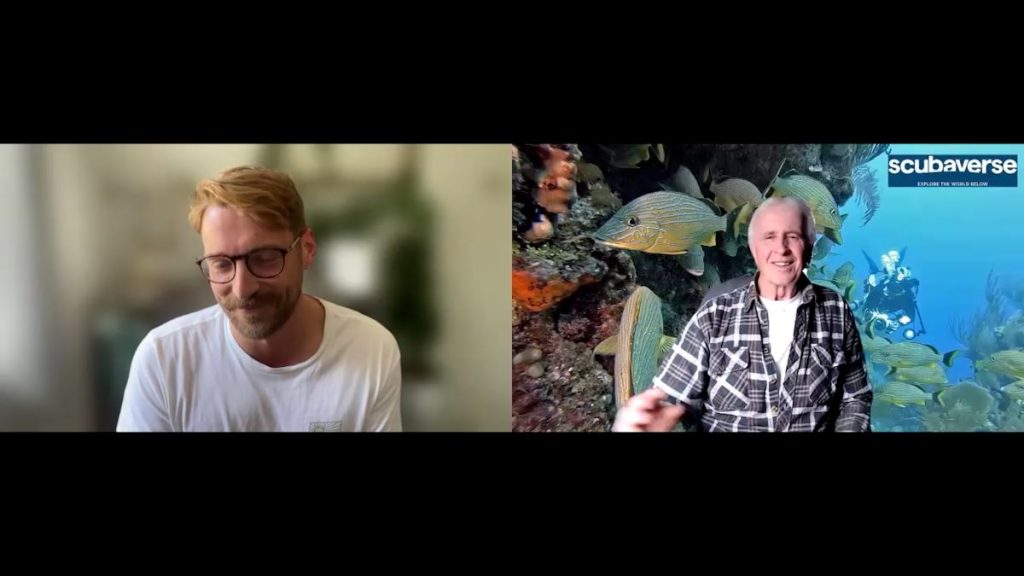
This was exactly how I came to connect with Ocean Crest Alliance who the Marine Foundation are forming a new partnership with. I was asked by the TerraMar project to be a guest host for the Daily Catch on Global Ocean TV. As with any request I receive, I researched the organisation and saw the great work they are doing. I would recommend you help this cause and that of our seas and get yourself an ocean passport.
I wanted to better understand what they would expect from me as a guest presenter, so I watched a number of previous episodes and was fortunate enough to discover one featuring Joseph Ierna, the founder of Ocean Crest Alliance. OCA is a 501(c)(3) non-profit organisation, registered in the United States and the Bahamas and was established to create awareness, to inspire, and to educate others about our Earth and Oceans and to illustrate the real issues we all face today. Joseph like myself has fallen in love with our Oceans and Seas and as I watched their Global TV episode I had that tingling feeling I get when I know something serendipitous is brewing.
I rode the wave, as they say, and looked up their website to learn their goal is ‘to Honor, Protect, and Restore the Health of the Worlds Oceans and the life of the Earth’s Systems through Conservation, Research, Education, Science and Technology programs’. These objectives share much in common with those of the Marine Foundation’s work and are very much in alignment with my own dreams. They were just lacking the key word that is the essence of our unique approach, creativity, and I knew I wanted to connect with them.
As I read on, I was very happy to learn they have worked closely with the community and government in establishing the 215,000 acre Marine Protected Area called Long Island Marine Management Area, or LIMMA for short. LIMMA from the onset has engaged the locals and are looking at some very innovative ways to establish long term economic based solutions. This innovative approach immediately struck me.
By unfortunate chance it has been discovered that the traditional approach to funding and implementing an MPA is fraught with problems, often implemented through a top down approach. There is insufficient socialisation and people resent the laws and restrictions that they feel are implemented by outsiders, taking away their livelihoods. “ A careful consideration of the receptivity of the fishing communities to MPAs is fundamental for their long term success.” (Agardy et al. 2003).
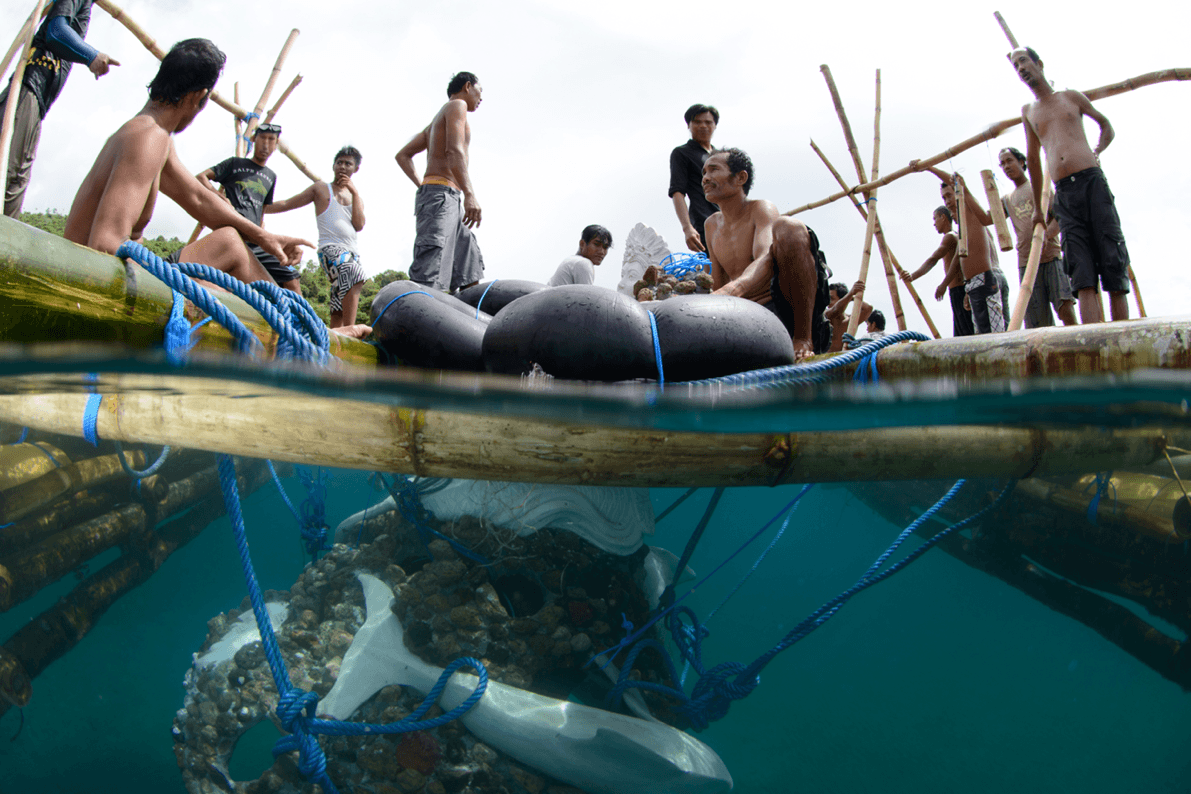
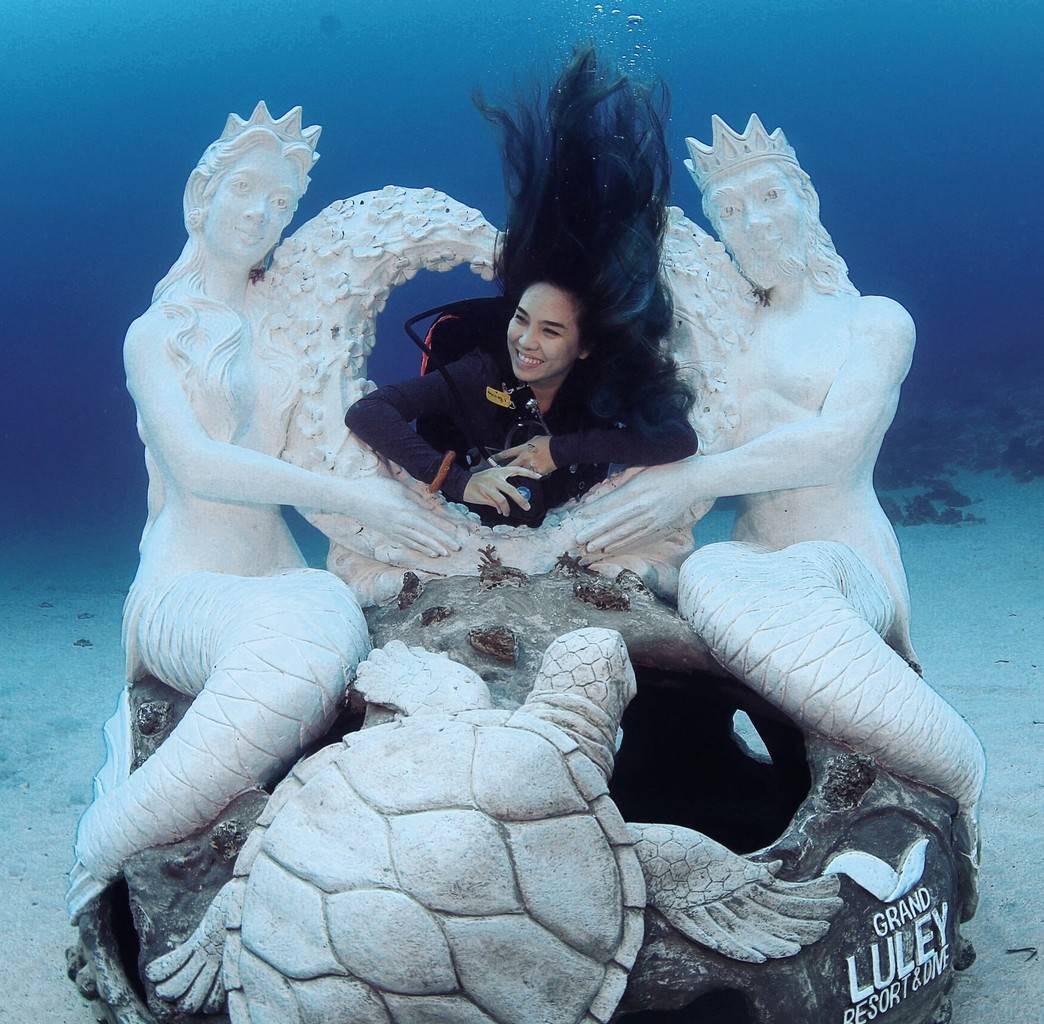
Even a seemingly windfall success of large amounts of funding has its downfalls, with initial investments going into complex infrastructures that cannot be sustained longterm, either economically or by an untrained local community. In the long term, leaving these MPA areas underfunded with no way to implement the laws and a local community who are not invested. I saw this first hand at Bunaken where we installed ‘the love mermaids” last November. This MPA was once considered such a success but I saw first hand evidence that dynamite fishing was still occurring; the reefs were suffering a decline in health and even though large funding had paid for boats and staff to enforce fishing restrictions, they were too scared to go out and defend their seas.
In a conversation I later had with Joseph (once I had asked Robert Foos of the Terra Project to connect us), we discussed that with people so desperate and so much money able to be made in illegal fishing, It is very complicated to enforce fishing restrictions… and dangerous.
An MPA’s best asset is a vested local community; if they feel empowered and positioned to benefit from its success, there is an inherent and genuine love for their heritage that is hard to buy! I hate being told what to do so I can only imagine what it must feel like for a fisherman who’s family has fished for generations that now they must now stop.
The Economist William Russell Easterly who specialises in economic development wrote an interesting book called The White Man’s Burden (the title refers to Rudyard Kipling’s famous poem of the same name). Controversially, Easterly suggests that ’messianic do-good missions are ultimately modern reincarnations of the infamous colonial conceit.’ I have seen many so called experts imposing theories thought out in institutions far away from the sea!
I am not suggesting that grants should be extinguished. We certainly rely on them, but valuing the local community and their wisdom and love for their sea is essential. A fisherman understands when their livelihood is under threat and like any father wishing to feed his family, I think learning how to take control and feel like a decider in the fortune of their own destiny is something that when not permitted brings tears to my eyes.
I love the OCA’s Lionfish Fisheries Program which has been developed to bring direct and immediate economic opportunity for large numbers of the local community. The program shows that removal of lionfish is an effective management tool to protect and preserve the biodiversity of the Bahamas’ native fish life, and a much welcome and needed addition to the local economy! These are an invasive species that have come into the Caribbean from The Indo Pacific in the hull of ships in their Ballast water. Ballast water is water carried in ships’ ballast tanks to improve stability and balance. The water is taken into the hull or discharged when cargo is unloaded or loaded to maintain weight or when a ship needs extra stability in foul weather. When ships take on the ballast water, plants and animals that live in the ocean are also picked up. The cargo travels around the Globe and the same animals are then released into foreign seas. The Lionfish look stunning but are predators, and destroy the eco-system’s delicate balance in their new marine home. They are challenging to catch as they have toxic spines but they are actually incredibly good to eat. On my recent trip to Belize I came across a jewellery artist who was cleverly making stunning earrings and other items from the tails and fins.
OCA is also establishing a Coral Nursery Restoration Program, and this is where The Marine Foundation comes in. We bring a uniquely creative approach; Our Living sculpture in the Sea program has proven highly effective as an aspect to a successful marine management strategy. I feel it was by a seemingly unfortunate events that I was even able to conceive the Living Sculpture in the sea Program. During my research it was divers love of wreck diving that seeded the concept. Ships that have come to an untimely end and sunk to the bottom of our seas only to become thriving marine eco-systems.
‘The notion of serendipity is a common occurrence throughout the history of scientific innovation such as Alexander Fleming’s accidental discovery of penicillin in 1928. Innovations presented as examples of serendipity have an important characteristic: they were made by individuals able to “see bridges where others saw holes” and connect events creatively, based on the perception of a significant link.’
Our times are calling to each and every one of us to be creative and innovative. We desperately need to realise we have some major challenges to face in our beautiful world both above and below and I am thrilled to announce The Marine Foundation’s new partnership with Ocean Crest Alliance.
“I have noticed that even those who assert that everything is predestined and that we can change nothing about it still look both ways before they cross the street.” – Stephen Hawking