Rarely filmed octopus caught changing colour (watch video)
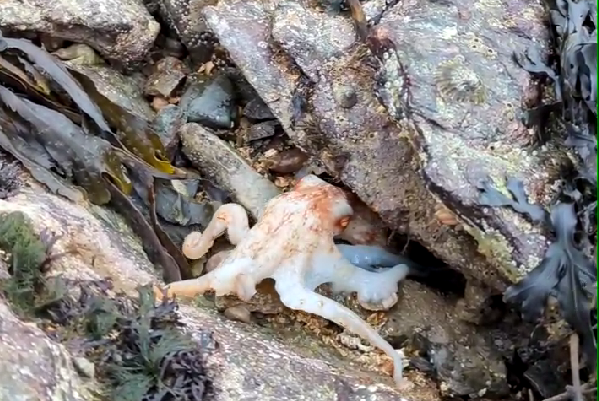
Beachgoers record footage of a curled octopus changing colour in rare footage on Welsh beach
The footage of the curled octopus was recorded by the Marine Conservation Society’s Hiraeth Yn Y Môr Project Assistant. Ciara Taylor was practicing marine identification skills around the shoreline by Menai Bridge beach, Anglesey (Ynys Môn), when fellow rockpoolers spotted some tentacles.
Ciara Taylor said, “I met two other young people who were rockpooling and one of them saw some tentacles sticking out from under a rock – they shouted over to me, so I ran over, and then we waited. It eventually came out and started crawling back towards the sea! We couldn’t believe it. It was an amazing reminder of the beautiful wildlife we have in North Wales and why we need to protect it.”
The footage shows white tentacles appearing from underneath a rock, and slowly the full body of the octopus appears, before it quickly changes colour to orange and crawls away across rocks and seaweed. The octopus made it safely back into the sea.
You can watch Ciara’s video of the octopus here.
The Marine Conservation Society’s Seasearch programme, which asks rockpoolers, snorkellers and divers to record marine life, reported an increase in octopus numbers in 2022.
Angus Jackson, Seasearch Data Officer at the Marine Conservation Society, said, “Curled octopus are found here all the time, and we get a handful of records every year. In contrast, we very seldom receive records for Mediterranean or common octopus. The summer and autumn of 2022 were fascinating exceptions, where there appeared to be a boom in the population of common octopus, and we received many records. Such booms have been noted in the past, but not for several decades”.
In 2023 Seasearch received more records of common octopus than usual, but not as many as in 2022. Octopus don’t live much more than a year, so it may be that the conditions that allowed the boom have changed.
The charity is asking for more people to join their Seasearch programme to help identify these kinds of trends and tell scientists more about our changing seas.
The Marine Conservation Society is the UK’s leading ocean charity, working towards cleaner, better-protected, healthier seas. The charity highlights the importance of our ocean, and the life within it, through working with governments, communities, and industry to take action to restore and protect the marine environment.
Ciara Taylor is Project Assistant on the Hiraeth Y Yn Môr project, a Nature Networks 2-funded project administered by the National Lottery Heritage Fund on behalf of Welsh Government. Hiraeth Y Yn Môr is a Conwy & Denbighshire-based, community-led initiative focussed on growing Ocean Literacy as a means to support the sustainable management of the Liverpool Bay/Bay Lerpwl SPA and community health & well-being. Led by the Marine Conservation Society, the project works collaboratively with Kinmel Bay & Towyn, Rhyl & Prestatyn’s communities to protect their local marine natural heritage through a variety of nature-based, indoor and virtual activities, events and opportunities.