Liveaboard Life & Legendary Wrecks: Exploring the Red Sea on Ghazala Adventure

Ghazala Adventure
After an overnight steam from the Brother Islands toward Abu Nuhas, we woke to find ourselves in Ras Mohammed National Park instead. The wind had other ideas overnight, but when the alternative was Anemone City, Shark and Yolanda, followed by the Thistlegorm and Dunraven, there were obviously no complaints.


Ras Mohammed
Our liveaboard was perfectly positioned over Anemone City, so the plan was simple: a giant stride off the back deck, a descent onto Anemone City, then keeping the reef to our right as we headed out into the blue toward Shark Reef. From there we would follow around the plateau and explore the wreckage of the Yolanda, before finishing the dive on Satellite Reef, where a zodiac would be waiting to pick us up.

It’s no surprise that this dive is considered one of the top ten dive destinations in the world. We descended onto Anemone City and were immediately greeted by a stunning array of anemones and, of course, their resident anemonefish. I could easily spend an entire dive photographing these little characters, but all too soon we were heading out into the blue toward the dramatic walls of Shark Reef.


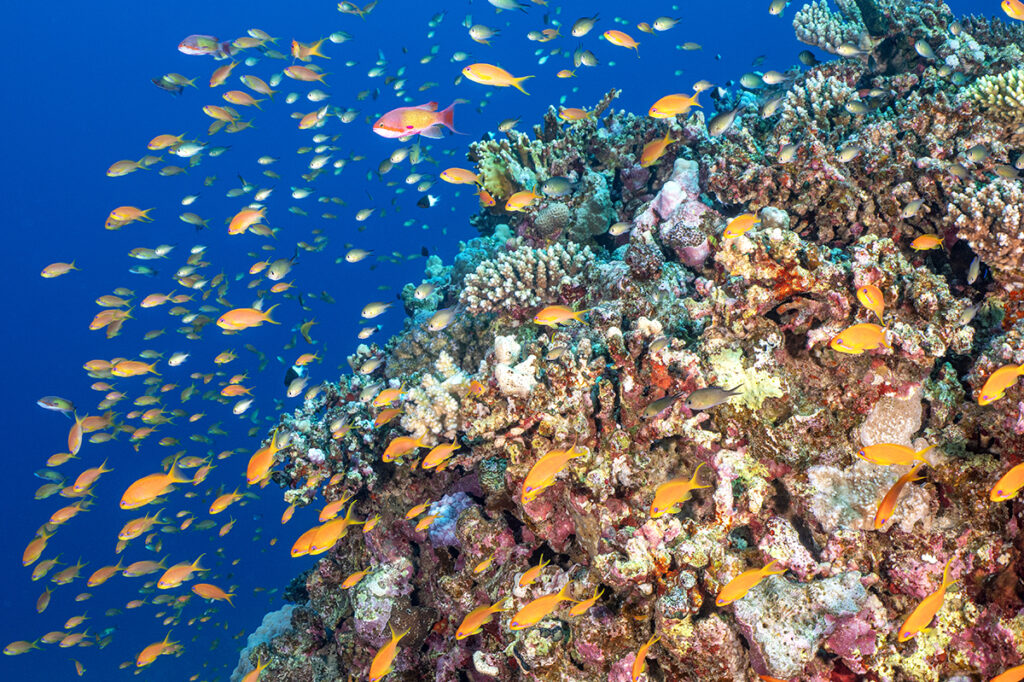
Along the way, shoals of Bohar snapper, jacks, and trevally swept past us. The reef walls were, as always, smothered in a profusion of colour and alive with clouds of anthias. A steady current carried us effortlessly onto the plateau, where we found pristine corals, overhangs packed with glassfish, and hunting batfish. On the far side lay the famous collection of toilets – cargo left behind by the Yolanda shipwreck.

We ended the dive with a safety stop at Satellite Reef and, once back on the surface, were collected by a zodiac and returned to the liveaboard. It was an incredible way to start the day, especially with the Thistlegorm and Dunraven still to come. Oh, and three meals a day, plus plenty of nibbles. Have I mentioned the food yet? There’s nothing quite like working up an appetite on a dive and returning to an incredible buffet.
With a delicious breakfast under the belt, it was time for the first briefing on one of the major highlights of the trip, the SS Thistlegorm.
Thistlegorm
The SS Thistlegorm was a British cargo steamship that departed Glasgow in June 1941, bound for Alexandria. Its cargo included Bedford trucks, armoured vehicles, Norton and BSA motorcycles, rifles, ammunition, aircraft parts, wellington boots, and even two steam locomotives. The locomotives were destined for the Egyptian National Railways, while the rest of the cargo was intended for Allied forces in Egypt. Traveling as part of a convoy, the Thistlegorm was delayed in the Suez Canal and moored at a supposedly “safe” anchorage. Unfortunately, two German Heinkel aircraft spotted her and dropped bombs on the stern, causing the ship to sink on 6 October 1941.

It wasn’t until the early 1950s that Jacques Cousteau discovered the wreck, guided by information from local fishermen. Recreational diving didn’t really take off at the site until the early 1990s. I first dived the Thistlegorm in that decade and have returned several times since, though you can never see it all in one visit, there’s always something new. On this trip, we were incredibly lucky to dive it three times: the first to explore the exterior, a night dive to see the smaller critters, and the following morning for a tour of the holds.


Our first dive was nothing short of spectacular. Our guide, Yasser, led us out onto the sand at around 30m to view the locomotive before we moved back to the main wreckage at the stern, where the bomb damage is still clearly visible. From there, we explored the heavy-calibre anti-aircraft gun and dropped down to admire the prominent propeller. By the time we headed back toward the bow, the current was starting to build. Yasser guided us into a gangway where we swam past the bridge to our stern line marked for the Ghazala Adventure, making our way up for the safety stop while casting one last, lingering gaze down at the incredible site below.


Back on board we were ready for our next meal of the day, lunch and a nap before our next briefing for a dive on the Dunraven. It’s true what they say about liveaboard diving, EAT.. SLEEP.. DIVE.. my idea of heaven.


Dunraven
The Dunraven is another British ship, which sank in an upside-down position near Ras Mohammed in 1876 after striking Beacon Rock. It’s a very accessible wreck, easily penetrated, with depths ranging from 15 to 30 meters.

We started the dive by swimming down to the propeller at the stern before ducking under the hull to explore the interior. Soft corals drape the structure, and swarms of glassfish take shelter under the overhangs. Inside, we spotted several moray eels, while the exterior was adorned with spectacular scorpionfish. It’s also a fantastic dive for glimpsing large groupers and shoals of reef fish.


We were sad to leave, but comfort awaited us as our third meal of the day was ready! Mini pizzas and fresh juices served on the sundeck after the dive felt like heaven. So, technically that makes four meals in a day … but let’s be honest, you can eat whatever you want when you’re diving, right?


The last dive of the day was back to the Thistlegorm for a night dive. I had to miss this one due to some camera issues but had lots of fun watching everyone kitting up and entering the water and generally hanging out with the crew. I suppose in this case I didn’t really deserve dinner afterwards but who’s counting 😉

In the next instalment we will be returning to the Thistlegorm to explore the holds, then heading off to the Kingston and the Barge, which is one of my absolute favourite bimbles.
Book your next diving adventure on Ghazala Adventure with Scuba Travel: www.scubatravel.com
Book your dive insurance with Dive Master Insurance: www.divemasterinsurance.com