Does Size Really Matter? Paul ‘Duxy’ Duxfield

Many underwater photographers are moving away from large DSLR and mirrorless rigs in favour of smaller, lighter camera systems. Is this simply about convenience, or has downsizing changed the way they photograph underwater? We asked a selection of underwater photographers to share their experiences.
For the fourth and final instalment in our mini-series, Does Size Really Matter?, we talk to Paul ‘Duxy’ Duxfield.

Paul ‘Duxy’ Duxfield is a well-known underwater photographer, writer, photo coach and dive travel host who has long championed the idea that great underwater photography doesn’t have to mean carrying a huge camera rig. A familiar face in the UK diving and underwater photography community, Duxy is known for his practical, no-nonsense approach to photography and his enthusiasm for getting the very best from smaller, more accessible camera systems. Having travelled and photographed extensively around the world, he firmly believes that creativity, technique and understanding your camera matter far more than the size of the kit in your hands.
Tell us about your camera journey.
What underwater camera system did you use previously, and what system are you using now?
I started out, like a lot of us of a certain age, ahem, with a late-series Nikonos film camera, and then, as the Sales Manager of Cameras Underwater, rode the crest of the early digital age. Currently, I use a combination of cameras. My regular ‘big rig’ is based around Micro Four Thirds, which I still use a lot, but as I now lead a lot of snorkelling tours, I also use an unhoused Olympus TG-7 with a fisheye lens and a small strobe, alongside a bevy of action cameras. I have an older GoPro 11 in a dedicated split-shot housing and a newer DJI Osmo Action 6 in an AOI housing with a corrective wide-angle lens attachment.


What prompted you to downsize?
Was it weight, travel restrictions, cost, ease of diving, changing photographic interests, or something else?
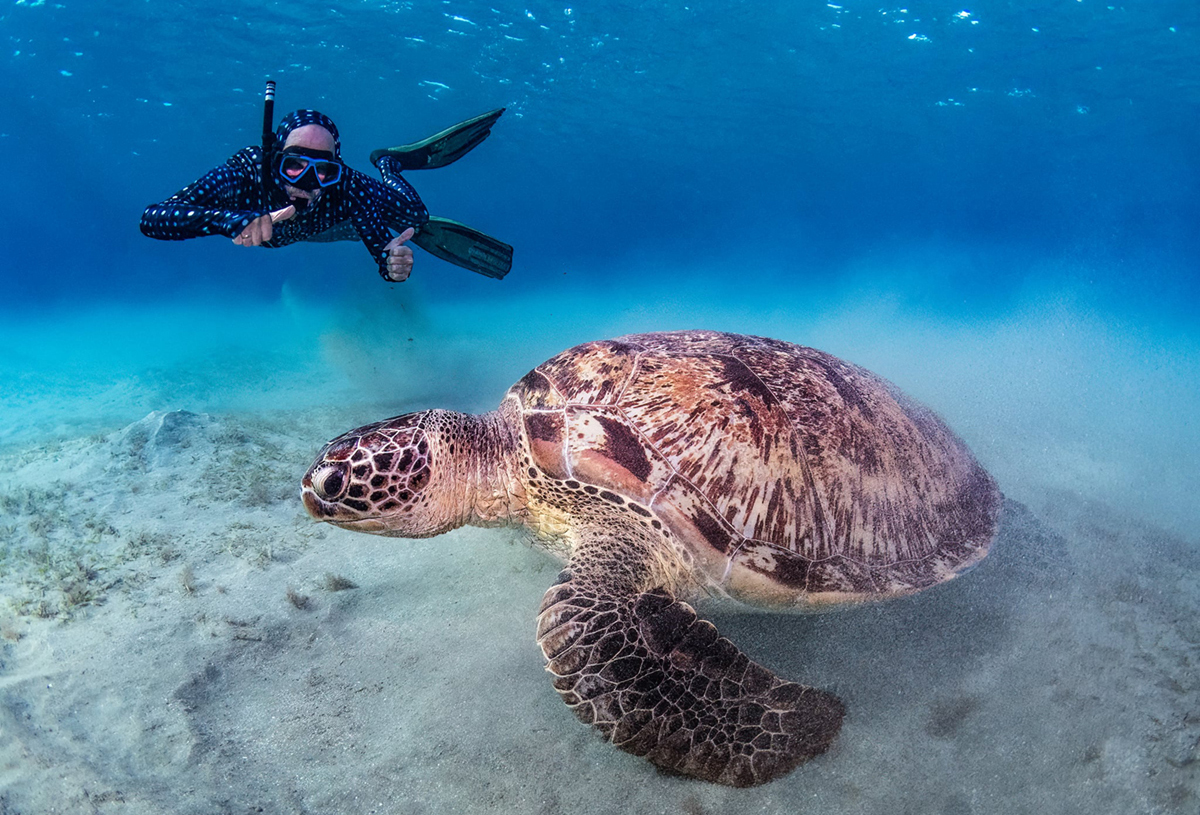
Absolutely weight and travel restrictions to a certain degree. However, a big factor on the snorkelling trips was that most of our guests rock up with Olympus TG-6s or TG-7s, and I want to show solidarity with them. Sort of like, “I’m using the same thing as you. Here’s how, with some simple, inexpensive accessories and tips on how to use them, you can also get great pictures.”
When I shoot with my big rig, with twin strobes and large domes, people assume it’s down to the equipment that I get good shots. If I’m shooting with the same camera as them, they quickly realise that’s not the case.

What have been the biggest benefits?
What do you enjoy most about shooting with a smaller system?
I love the freedom it gives me. Particularly while snorkelling, I’m sometimes using up to three separate camera setups. I have an Olympus TG-7 and fisheye, which is a wet lens, occasionally with a small Backscatter MF-2 strobe and a 3D-printed Sea & Sea strobe connector that facilitates the strobe. I’ll also have a DJI Osmo Action 6 in an AOI housing with an AOI wet lens, which reduces its minimum focus distance and corrects for underwater distortion and optical issues. Then, in another pocket of my Apeks Tech Shorts, I can fit the dome-housed GoPro 11 for when split shots present themselves.
What have you sacrificed?
Are there any compromises in image quality, handling, battery life, ergonomics, or functionality?
Obviously, these tiny cameras have sensors which are much smaller than Micro Four Thirds or larger systems, so dynamic range, low-light performance and resolution take a hit. If you’re a pixel peeper, they’re not as good. However, the more relevant question is: are they good enough? A resounding yes for social media, and you’ll get decent results printed up to A4, maybe bigger. But that’s not the point. They definitely allow you opportunities not afforded by a bigger setup, and from an ergonomics point of view, I can put these tiny cameras in positions that would be impossible with a bigger setup.

Has downsizing changed the way you shoot?
Has it influenced the subjects you photograph, your composition, or your diving style?
It’s made me work harder, think outside the box and overcome technical issues in novel ways, which has actually added to my knowledge base and helped me in all areas of my underwater photography.
How does it compare underwater?
Do you find the smaller system easier to manage in currents, when entering and exiting the water, or on longer dives?
Much easier in all these scenarios. As I mentioned earlier, I usually have at least two, often three, cameras with me, so battery life is rarely an issue on longer sessions in the water. As I’m usually using these cameras more for snorkelling than diving, I’m often in the water for up to two hours.
Do you miss anything about your previous setup?
No, because I still use my other setups when the situation dictates. When I’m working and leading snorkel tours, I don’t even take the big rig along. But if I’m on a dive trip, I use my bigger rig and also press the housed DJI Osmo Action 6 and lens into service to cover wide-angle and/or video, especially if I’m shooting macro on the bigger rig. It just fits into a pocket of my tech shorts.
Are there features or capabilities that you simply can’t replicate with a smaller system?
If I’m using an action camera like my DJI or GoPro solely, then they’re a bit of a one-trick pony in that they’re not great for macro. But, to be honest, I rarely have only one with me, and the Olympus TG-7 is famously great for macro.
I’d be fibbing, though, if I didn’t say that I sometimes miss the performance of a larger-sensor camera in low light — but only sometimes.
What about lenses?
Do you still have the same creative flexibility with lenses and ports, or do you find yourself working differently?

There’s a large ecosystem of lenses and accessories from third-party vendors, particularly strobes and housings for the Olympus cameras. I can shoot close-focus fisheye and then swap to extreme macro on the same snorkel. I’m of the opinion that it’s best not to complain about what you can’t do and instead focus on what you can. It’s a mantra I try to stick to personally, but I also pass it on to folk on any of my photo workshops, whatever camera system they use. Often, creativity is fostered when you’ve got less choice of toys, in my opinion.
Looking back, would you make the same decision again?
Would you ever return to a larger camera system? Why or why not?
As I still use a larger camera system, this isn’t a decision I need to make. I use all these cameras, and they all have their pluses and minuses.

Do you have any regrets?
If you could do it all again, is there anything you would do differently?
No regrets at all. I would do it all again, and if I could do it all again, I would retrain as a dentist or an IT technician, as then I’d have a lot more money to play with more toys!
But joking aside, I honestly think that being impoverished relative to a lot of folk I meet in our funny little world has only made me try new things and push the boundaries of what is possible with what is really inexpensive gear by comparison with a lot of the kit I drool over and can’t afford.
What advice would you give someone buying their first underwater camera system?
Should beginners start small and upgrade later, or invest in a larger system from the outset?
Even if they have the budget, starting out with comparatively inexpensive compact kit can only benefit beginners. Better to spend the money saved on dive or snorkel trips instead. Get comfortable with diving with a camera and using the available light. Buy strobes and lenses once you’ve become proficient. When you then buy a bigger rig, keep shooting with the smaller rig, as a lot of the time it’ll still be a very valid choice.
Finally… does size really matter?
In one sentence, tell us whether downsizing has made you a better underwater photographer.
I think shooting with a smaller camera, with less in the way of full manual control, has made me a better, more flexible teacher of underwater photography. Finding ways to get around the luxury of total manual control and forcing these cameras to do things they were never designed to do has been great.
I love being able to speak fluently in Olympus TG, GoPro or DJI, alongside my older knowledge base of everything from full-frame through to Micro Four Thirds. I’m getting older, and it keeps my brain fresh.

And perhaps that’s the answer to the question we’ve been asking throughout this series. Size does matter — but not necessarily in the way we might think. The best underwater camera system isn’t always the biggest, most expensive or most technically advanced. Sometimes, it’s simply the one that allows you to get in the water, enjoy your photography and come home with the pictures you wanted to take….