Book Review: Dragon Sea (2007) by Frank Pope

Dragon Sea, by Frank Pope, tells the true story of the location, combined archaeological survey of a large, five-hundred year old wreck and salvage of over 250,000 Vietnamese ceramic artefacts from the Hoi Ann shipwreck. It also charts the complex negotiation with government departments, legal and cultural bodies in Vietnam, as well as international groups, which had a vested interest in the outcome of the excavations and sale of artefacts.
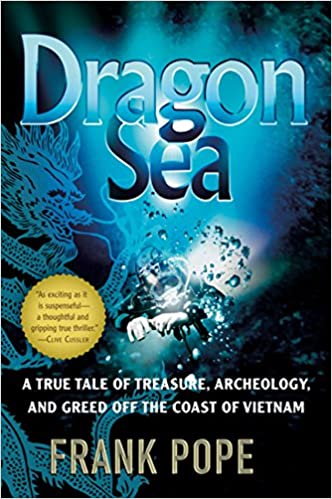 It was a sensitive and expensive project. The ransacking of ancient Chinese porcelain artefacts from the wreck of the Dutch East India Company Geldermalsen, a few years earlier, had generated US$20 Million at auction but prompted furious international condemnation at the destruction of the wreck site for profit. In addition to managerial and ethical problems, the Vietnamese Hoi Ann shipwreck rested on the seabed over seventy metres below the surface in the turbulent and typhoon prone South China Sea. It would be a testing site on which to work.
At the outset the endeavour seemed to offer so much to everyone involved. The wreck site was a time capsule, sealed on the day of its sinking. It offered insights into Vietnamese culture and ceramics made during the golden days of the civilization. The Chief Archaeologist explained “shipwrecks preserve information in a way that very few land sites could – by freezing a moment in time” (p. 8).There was the prospect of huge financial rewards to the businessman leading the consortium of investors. Divers and technicians, managers and workmen, as well as Vietnamese institutions, all stood to benefit.
In his account Frank Pope combines the excitement of both archaeologists and accountants as pristine artefacts are uncovered and brought to the surface. His descriptions are vivid: “fragile kendis and ewers, vases, and large blue-and-white storage jars had cascaded down as the wood around them disintegrated” (p. 196). The numerous sketches Pope includes in his book are useful, but actual photographs of some of the artefacts and scenes would have been a valuable addition.
Throughout the book a central theme emerges; it’s the cost cutting measures under which the project operated. The author reveals how these pressures and accompanying resentments grew within the team as a result of these measures. For the divers, their work time in saturation (living inside a pressurized chamber breathing helium and oxygen, and working at seventy metres plus) was extended far beyond the recognised limit. Eventually, when they emerge after fifty-nine days of saturation diving, they were “thin and bearded, their skin yellowed and covered in rashes and lesions” (p.259).
Calm waters do not typify the South China Sea – especially as the typhoon season approaches. A recreational diver may experience surge, current and turbulent water; but is not working for twelve hours a day, for weeks, at a depth of more than seventy metres! The effect of surface sea conditions on a dive platform, waves and swell, are magnified underwater. The diving bell and the umbilical attached to a diver are continuously wrenched up and dropped down in the current. Even in calmer conditions the process of negotiating the metal grid positioned over the wreck is problematic. It “was like trying to clamber through a climbing frame on a moonless night with a gale blowing, wearing full dive gear, trailing a cable and carrying a heavy basket of fragile ceramics” (p.209).
Pope skilfully describes the changing atmosphere surrounding the project – both above the water and below. Close, personal friendships become strained as fatigue and adverse weather, financial constraints and day to day problems begin to overwhelm those involved. The uneasy balance between rigorous archaeological practise and the economic need to recover artefacts takes centre stage. The Chief Archaeologist “couldn’t shake the fear that despite his instructions, the divers were ignoring anything that wasn’t ceramic.” The businessman believed the actions of the archaeologist were sabotaging the recovery of artefacts. The crescendo, the sale of the artefacts from the Hoi Ann shipwreck, is not what you may have expected.
Perhaps the outstanding feature of Dragon Sea is the way Frank Pope succeeds in building a relationship between the main characters and the reader. You want a diver to survive, another character to change, broken relationships mended. The closing sections provide a pleasant summary of what subsequently happened to them. However, perhaps the most salutary comment is reserved for the state of marine archaeology in many parts of the world. Frank Pope writes “In most of Southeast Asia, however, it is still open season on the seabed.” (p. 315)
Dragon Sea (2007)
- By Frank Pope
- New York: Harcourt Books
- ISBN 9780156033299
- 341 pp
Frank Pope obtained a degree in Zoology from Edinburgh University and is Ocean Correspondent for The Times newspaper. He has worked on underwater expeditions under the auspices of Oxford MARE (Maritime Archeological Research and Excavation), including the salvage of Lord Nelson’s flagship Agamemnon. His most recent book is 72 hours (2013); the Royal Navy’s dramatic race to save the crew trapped inside a Russian submarine.
Find out more about Professor Fred Lockwood, who is also a published author, at www.fredlockwood.co.uk.