MCS want you to report jellyfish and turtles on our shores

 The Marine Conservation Society’s Wildlife Sightings programme focusses on two key marine animals: jellyfish and, as a result, turtles. Both are vital in supporting ocean biodiversity and are indicators of changes in our ocean, like warming waters.
Since 2003, when the Marine Conservation Society’s Wildlife Sightings programme began, the charity has had 18,580 sightings reported – 18,357 of jellyfish and 223 of turtles.
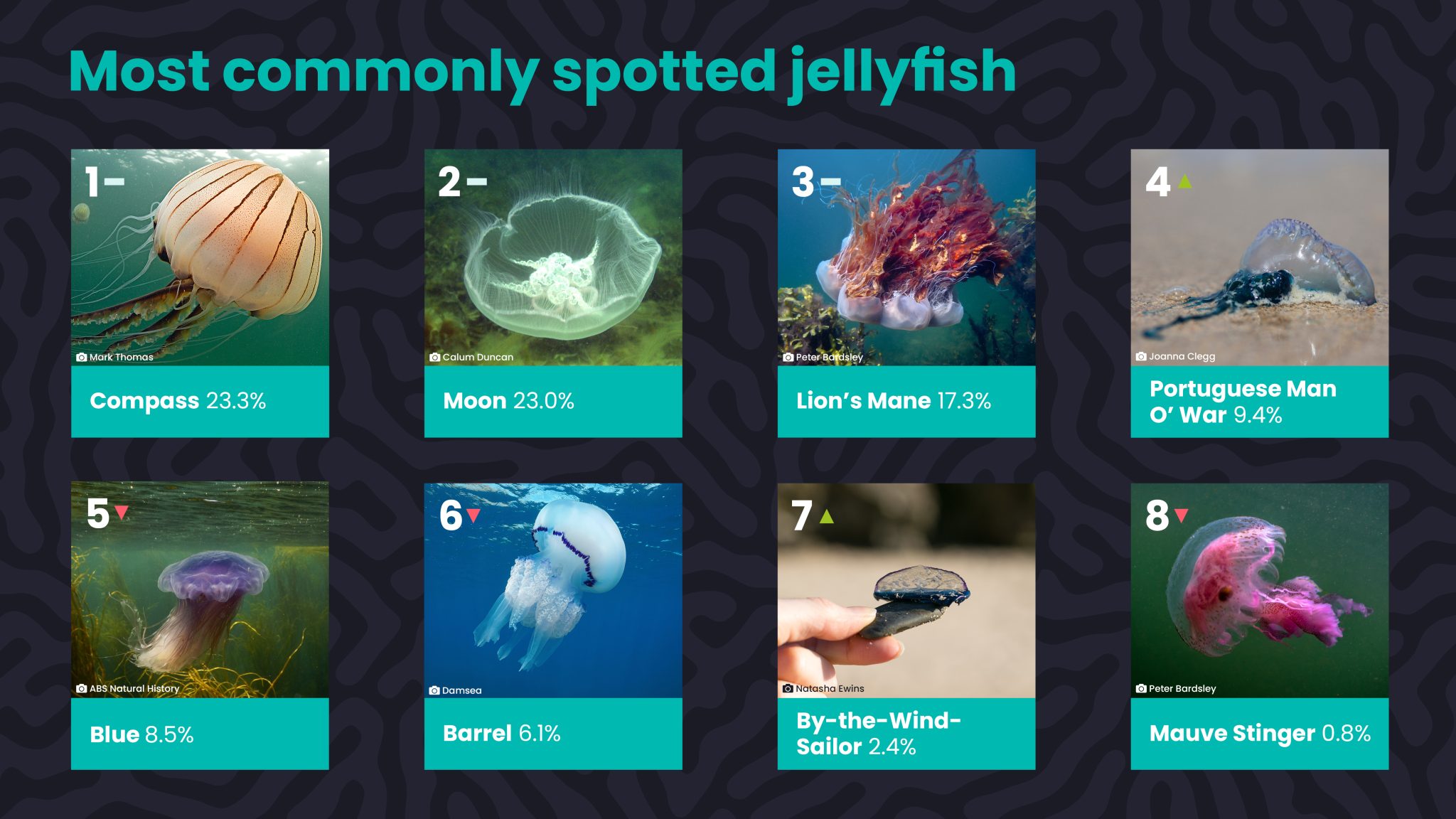
Jellyfish can be spotted year-round in UK and Irish seas, but larger blooms are more likely to appear in spring, lasting through until autumn. Jellyfish sighting records from 2022 show that the most frequently reported jellyfish species were the moon jellyfish, accounting for 22% of sightings, followed by the barrel jellyfish at 21%. The compass jellyfish and lion’s mane jellyfish were also commonly sighted, comprising 19% and 15% of the reports, respectively. These findings provide valuable insights into the prevalence of jellyfish species in UK and Irish seas.
Sightings of jellyfish and turtles should be reported online when spotted by beach or sea goers to support ongoing research. Identification and reporting take just a few minutes using the charity’s easy identification cards and online form.
During spring and summer, jellyfish arrive in the UK and Ireland’s warming waters to feed, feasting on plankton blooms and the array of eggs and larvae of fish, crustaceans, starfish and molluscs which are common at this time of year.

With healthy fish stocks and rich biodiversity, jellyfish quickly become part of an effective food chain. Many species, from tuna to turtles, will feed on jellyfish of various sizes. Supported by a rich and diverse ocean ecosystem, jellyfish link the microscopic world of plankton to larger marine animals and the ocean around them.
The charity’s data shows an increasing trend in some species being spotted on our shores over the last 20 years, such as Portuguese man o’War. Research has suggested that an increase in some jellyfish numbers around UK could be related to climate change, however, currently there isn’t enough evidence to make this link. The Marine Conservation Society’s Wildlife Sightings programme aims to collect long term data which can be used as a reference to study the reality of jellyfish trends in UK waters.
Jellyfish are especially appealing for marine turtles to eat. Six of the world’s seven marine turtle species have been spotted in UK seas, some of which arrive due to large abundances of jellyfish in spring and summer. The charity also reported an increase in marine turtles earlier this year, when strong currents and winds potentially blew turtles off their usual course and into our seas. The charity has a Turtle Code information sheet which shows what to do with a beached turtle.
The largest sea turtle, and the most common in UK and Irish seas, is the leatherback, which has a ‘vulnerable’ conservation status. Reporting sightings of these incredible creatures will support the Marine Conservation Society and others in understanding their movements, potential threats and how better to protect them.
The charity’s volunteers submitted 223 turtle sightings since 2003, which feeds into a national database which recorded nearly 1,000 (946) turtle sightings over the same period. The research is used to inform policies and introduce conservation strategies to better protect our ocean and its inhabitants.
Dr Peter Richardson, Head of Ocean Recovery at the Marine Conservation Society, said:“Without your data, we wouldn’t be able to prove that our ocean is facing problems, or push for solutions that are backed by science. Data on jellyfish and turtles helps us build a picture of life in UK and Irish seas and track any changes that may occur because of things like climate change.
“Since 2003, when our Wildlife Sightings programme began, you’ve reported over 18,000 sightings of jellyfish and turtles. We want to reach 20,000 sightings to mark our 20th year of tracking these species. Every contribution to our database is crucial in learning about our seas and helps us fight to protect them.”
The Marine Conservation Society uses wildlife sightings by citizen scientists to:
- Discover how jellyfish and turtle populations are changing around the UK – specifically when and where they are occurring each year
- Investigate trends in turtle sightings to find out more about how they use our waters
- Explore whether jellyfish distribution can tell us more about where leatherback turtle feeding grounds may be
For more information on how to identify jellyfish and turtles, and to report a sighting, please visit the Marine Conservation Society’s website: www.mcsuk.org/sightings.