Future Focus: Anya Hartwig

In each instalment of Future Focus, we speak with past and present students of the Marine & Natural History Photography BA(Hons) course at Falmouth University about their experiences, challenges, and successes on the course.

Anya Hartwig – 3rd Year Student
Gina: What first attracted you to the Marine & Natural History Photography course at Falmouth?
Anya: Walking around a careers fair at my school, I looked inside a Falmouth prospectus, looking for the word “marine”. Wanting to do something surrounding the ocean, it was the only kind of course I was looking for. I read the words “Marine & Natural History Photography” and thought it was a course made for me; someone who loves art, diving and the ocean. I was instantly filled with doubt, wondering if I would be good enough, where this might take me, and whether it mattered if I hadn’t studied photography before. How much I loved diving and art, and wanting to combine them is what drove me to do it anyway, despite these fears. Since then, I’ve never looked back!
Gina: How have your photography skills developed since starting the degree?
Anya: Before starting this course, my photography skills were very limited. I had never experimented with settings, aside from to correct exposure, or even used a different lens to my 18-55mm! Since starting, I have used a massive range of cameras, lenses and techniques both underwater and on land. I have grown my skills to now include super-macro photography, fish portraits and rockpooling. I’ve pushed myself to film underwater and experiment with a variety of techniques, like bubble bokeh for example.


I’ve also developed my confidence in photography, in part due to the Red Sea diving trip, which allowed me to push my macro skills even further, capturing subjects I never would have dreamed of previously! For example, a grouper having its mouth cleaned, a nudibranch smaller than a grain of rice, and a clownfish peering through anemone.


I’ve also learned to find and photograph the extraordinary underwater life in UK waters, like Solar Powered Sea Slugs, Long Spined Sea Scorpions and the Common Octopus, and even Grey Seals!


Diving in the UK
Gina: What’s the most memorable UK dive you’ve had during your time on the course?
Anya: It’s tough to pick my most memorable UK dive on the course, but one of my favourites definitely was seeing a barrel jellyfish at the end of a dive! Despite many of us having a macro lens, we spent the rest of the dive photographing the largest jellyfish I had ever seen. It led us back to shore, until we were all essentially snorkelling in dive equipment, swimming along the surface to give it space! I was having so much fun that I had to be reminded that it was time to go, as our allotted dive time was up!
Gina: Has diving in the UK changed the way you think about local marine life and conservation?
Anya: Before starting this course, I had no idea about the incredible biodiversity in UK marine life, particularly within rockpools. Before we were able to dive with the cameras, I was so eager to start that I spent hours practising in rockpools, lying on the bottom and finding more life than I could’ve imagined through the viewfinder of a camera. When we started diving at Silver Steps in Falmouth, I was shocked at the amount of Spider Crabs in particular. When I heard that people illegally hunt and eat even smaller juvenile crabs, I was appalled. Seeing underwater life up close not only highlights their beauty, but how important they are. It makes you appreciate the ocean, not just as a habitat but an entire world filled with these pockets of incredible biodiversity, life that survives in the harshest conditions. Without the experience of diving in their environment, I wouldn’t have fully understood the importance of conserving it.
Marine Life & Projects
Gina: What has been the most surprising or unusual marine life you’ve photographed here?
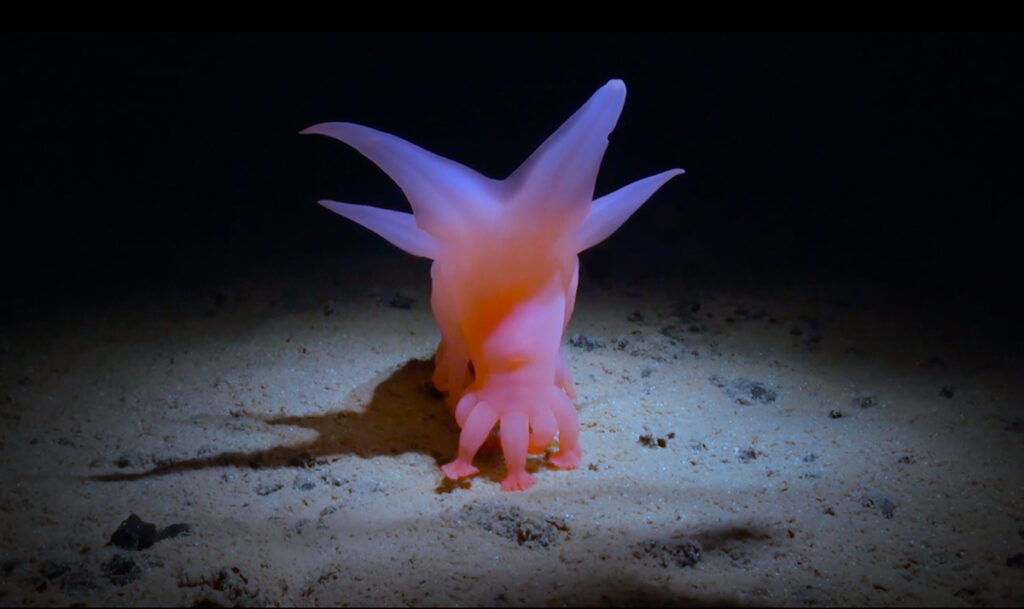
Anya: My most unusual marine life find was in a rockpool on Castle Beach; the Solar Powered Sea Slug. It was the first sea slug I ever spotted, and I immediately fell in love with photographing them. Since then, I have made a short film based on them, and plan to create a photography series on them for my third year project. What makes them interesting is their ability to extract chloroplasts from the algae they eat, and use them to photosynthesise. This process is called kleptoplasty, and is extremely rare in UK wildlife, with it being the only sea slug in the UK capable of doing this for long periods. Besides being stunningly beautiful, their midsections also appear to glow under strobe light, a fascinating effect that makes them seem even more unusual.


Gina: Which project or assignment has been the most rewarding for you so far?

Teaching & Support
Gina: How have the teaching team and dive team supported your development?
Anya: From teaching us how to assemble and use the cameras, to providing a sounding board for upcoming projects, the dive team has been instrumental in my development as a photographer. Without the constant support from staff, I would not have known how to approach many of my projects and wouldn’t have had the courage to experiment. This helped me from becoming discouraged during difficult shoots, or when learning new techniques. Having that helping hand (quite literally on a lot of dives), and a great source of feedback has also grown my confidence. They gave feedback every step of the way, from our first dives to our first exhibition (based on the Red Sea diving trip).
By showing us their own photography also, they inspire us to trial new techniques and push our skills even further. They also encourage us to find our own style, and don’t force us to force our work into a box it doesn’t belong in. Without talking to the dive team between or at dives, I wouldn’t have had the confidence to fully devote my projects towards macro photography and wouldn’t now get to feel proud of the work I have created in that style.
Most of all, they encourage us to get out there and get shooting, no matter how daunting the technique!
Gina: What role has feedback and peer support played in shaping your work?
Anya: Crowding behind a camera LCD screen after a dive creates a real feel of community and support. By getting instant feedback at dives, you grow in confidence and learn to celebrate the progress you have made so far. Peers have pointed out interesting things about images I wouldn’t have spotted. When it comes to deadlines, there’s a lot of time spent together huddled at computers, trying to narrow down image choices. Getting everyone’s feedback, from multiple different viewpoints, helps me to create my final portfolio. The staff’s feedback also helps you spot details an untrained eye would have missed, like a small fish cleaning a grouper’s mouth! Dive instructors, whether from platforms like BSOUP or in person, have given feedback which has shaped my work. For example, I was once told that small shrimp can often be found around a Moray Eels cave opening, something I started to notice throughout my images of them. The underwater photography community has shaped my work over the last two years into something I’m proud of, whether via peers, the dive team, or even other photographers online.
Personal Growth
Gina: What’s been your proudest achievement on the course so far?
Anya: Some of my proudest achievements are the different ways I have gotten my work out there. It’s difficult to choose the way that means the most, but in the end, seeing my work on the wall for the first time, at the Egypt exhibition, was the proudest moment of my university career. Family getting a glimpse into your work, along with famous names in the field of underwater photography, was an amazing feeling. Getting to see it in print in a magazine at the dive show was also a great highlight. And finally, seeing one my pictures (although not an underwater photo) in a BBC article for the first time was also an incredible experience.
Gina: Have you developed any particular style or technical focus since joining?
Anya: My style is rooted in the world of macro and super-macro photography. Since before I was a photographer, I have always been obsessed with the finer details on dives, wanting to get closer and explore the tiny crevices and cracks of the underwater world. My way of doing that is through a macro lens. As well as this, I also fell in love with shooting tiny subjects, such as nudibranchs or Antheas. I think my work is defined by species portraits, though not always in the way you might expect. In particular, I love using techniques to show an ordinary subject as something beautiful. Sometimes, I focus on smaller details of my subjects, like their eyes, or use an interesting background technique, like bubble bokeh. Variations of this technique is something I plan to explore in my next project, trialling it on new subjects like the Solar Powered Sea Slug. In my future career however, I hope to do a series on eyes in the macro, as this is one of my favourite details to capture on an underwater subject.

Looking Ahead
Gina: How do you see this degree helping you in your future career?
Anya: This degree has definitely been the foundation of my career, as it provided me with the equipment and instruction to grow my skills in underwater photography. It took me from never having taken a photo on a dive, to becoming an underwater macro enthusiast. It has also introduced me to a variety of other photographers, who I hope to remain in contact with, or even collaborate with in future. Since underwater photography is still quite niche, this degree gives you the opportunity to grow your skills amongst peers and support each other throughout. It gives you access to incredible equipment, brilliant feedback, and dive sites you never would have had the chance to explore before. Finally, it has shown me that an expensive trip abroad is not the only way to take underwater photos and made me appreciate the vast amount of life seen on our own shores, whether in a shallow rockpool, or hidden in the deepest crevice on a dive. It has also helped put my foot in the door for future opportunities in this field, even though I am still only taking my first steps into it!
Gina: What advice would you give to new students thinking about joining the course?
Anya: I think I’d tell a new student to throw themselves into the world of diving, not just to get the qualifications they need to join the course, but to have that foundation of diving skills, prior to throwing a camera in the mix! Personally, I didn’t have the best portfolio before I joined, and I’d want a new student to know that it’s okay to not quite know what they’re doing yet! As well as this, I’d tell them to read “Underwater Photography Masterclass” by Alex Mustard, as it’s what inspired me, and is an incredible book for an aspiring photographer to read. I’d suggest they look at as many underwater photographer’s works as they can, to learn what they might want to try in the future. Most of all, I’d say that they should throw themselves into it, try every technique they want to, ask all the questions they can think of and not be afraid to pick up that camera and go diving!