Book Review: Last Man Off (2014)

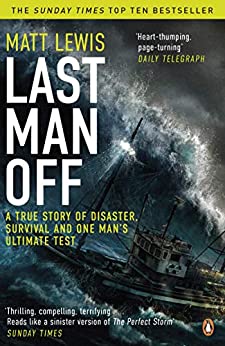 It was his first job after graduating as a Marine Biologist. Matt Lewis joined a deep sea fishing trawler, the MFV Sudurhavid, in Cape Town as an independent observer. His job was to sample whatever they caught on their long line – a three kilometre length of rope with thousands of baited hooks attached. In his own words he was ‘a university upstart recording the conduct of hardened fishermen.’ (p.6) He was also performing his work thousands of miles from land in the notoriously turbulent and cold Southern Ocean between Cape Town and the South Pole.
Matt vividly describes the daunting sea conditions; Force 8 winds and driving sleet, ten metre swells and sub zero sea water. In detail he recounts the exhausting monotony of eating, working and sleeping on a boat ‘rolling and pitching like a rodeo bull’. (p. 78). By any standards the working conditions were appalling as men were swept off their feet by ice-cold cascading water only to find themselves awash in the blood and guts of processed fish.
On 6th June 1998 the over laden MFV Sudurhavid began taking on water. Hatches and chutes designed to protect the workers and boat had been ‘modified’ to speed up the work. It allowed seawater from mountainous waves to penetrate the boat. Drains became clogged and pumps failed as the boat was pummelled by massive waves. Requests to cut loose the long line to help manoeuvring… warnings and then pleas to the captain and senior officers to stop fishing and seek shelter were ignored. A deteriorating situation rapidly got worse. Matt asks: ‘How could the most experienced men on the boat just ignore what was going on?’ (p. 92).
In a minute by minute, hour by hour account Matt Lewis describes the unfolding disaster. He provides a vivid account of the mounting chaos and selfish actions of individuals, the lack of leadership and how poorly prepared crew had to abandon ship in terrifying conditions. Thirty-eight men took to life rafts but many wouldn’t survive the bone chilling cold. Inside a flooded life raft Matt explained how he was ‘…balanced not on the floor of the raft, but on the corpses of colleagues, but I was too cold to care.’ (p. 159)
Few of us will have experienced the fury of a storm in the Southern Ocean. Probably even fewer of us have experience of deep sea fishing or survival in ice-cold water inside a life raft. However, the account by Matt Lewes will bring you uncomfortably close to the real thing. He acknowledges that his account of the sinking of the MFV Sudurhavid, years after the event, is a compendium of accounts from other survivors. However, this doesn’t detract from the impact it provides. The crew lists, pen portraits of crew members and numerous photographs makes their survival and deaths more poignant.
Accurately describing life and work inside a long line deep sea fishing trawler isn’t easy. Recounting the dramatic event of it sinking and harrowing events in a life raft is a personal challenge. It is one that Matt Lewis achieves with some skill. His provision of glossary of terms, boat plans and maps make the account both credible and readable. Furthermore, the forty colour photographs visually take you to these places. They bring people to life and acknowledge their death. Matt Lewis wanted his book to be an honest memorial to those on board the Sudurhavid when she foundered. It may not be the most comfortable reading but it is certainly worth the effort.
Last Man Off (2014)
- by Matt Lewis
- London: Viking
- 229 pp
- ISBN 9780241002780
Matt Lewis lives in rural Scotland near Aberdeen with his wife and children. His daughter, Camila, is named after the Chilean fishing boat, the Isla Camila, which saved his life.
Find out more about the reviewer, Professor Fred Lockwood, who is also a published author at www.fredlockwood.co.uk.