Why rebreathers are changing the game for underwater photographers
Most of us learned to dive on open circuit. You draw gas from a cylinder, breathe it in, and blow it straight back out again as a stream of bubbles. Here’s the thing though: with every one of those breaths, you’re only actually using about 4 percent of the oxygen in it. The rest, something like 17 percent oxygen, just gets exhaled straight out into the water along with a fair amount of noise. It’s quick, it’s simple, and it’s what most of us still use when we’re diving with a camera. Minimal training, minimal fuss. Regulator on, DIN or international fitting, BCD clipped up, and you’re rolling backwards off the boat. Add a bit of nitrox and you buy yourself some extra bottom time. For most shoots, that’s more than enough.
 But what if you didn’t waste all that unused oxygen? What if a loop scrubbed the carbon dioxide out of each breath, topped the oxygen back up to whatever level you needed, and let you breathe the same gas around and around instead of throwing most of it away? You’d stay down for longer. A lot longer, potentially up to ten times longer than a single cylinder would give you. You’d offgas nitrogen more efficiently too, because the loop can vary the oxygen partial pressure through the dive rather than sticking you with one fixed mix. And because none of that gas is venting out as bubbles, you’d lose the noise that sends fish scattering the moment you get close.
That’s a rebreather.
I’ll say upfront that rebreathers are brilliant tools, but they are unforgiving if you haven’t been trained properly, and getting qualified on one is a serious undertaking that deserves its own article entirely. What I want to talk about here is when a rebreather actually earns its place in a photographer’s or videographer’s kit bag, and there’s no better example than a job I shot last month.
The Manado Depth Competition: Two Years, Two Very Different Dives
Last year I covered the Manado freediving depth competition on open circuit, and I covered it again this year on a closed circuit rebreather. The contrast taught me more about what CCR can do for camera work than any classroom ever could.
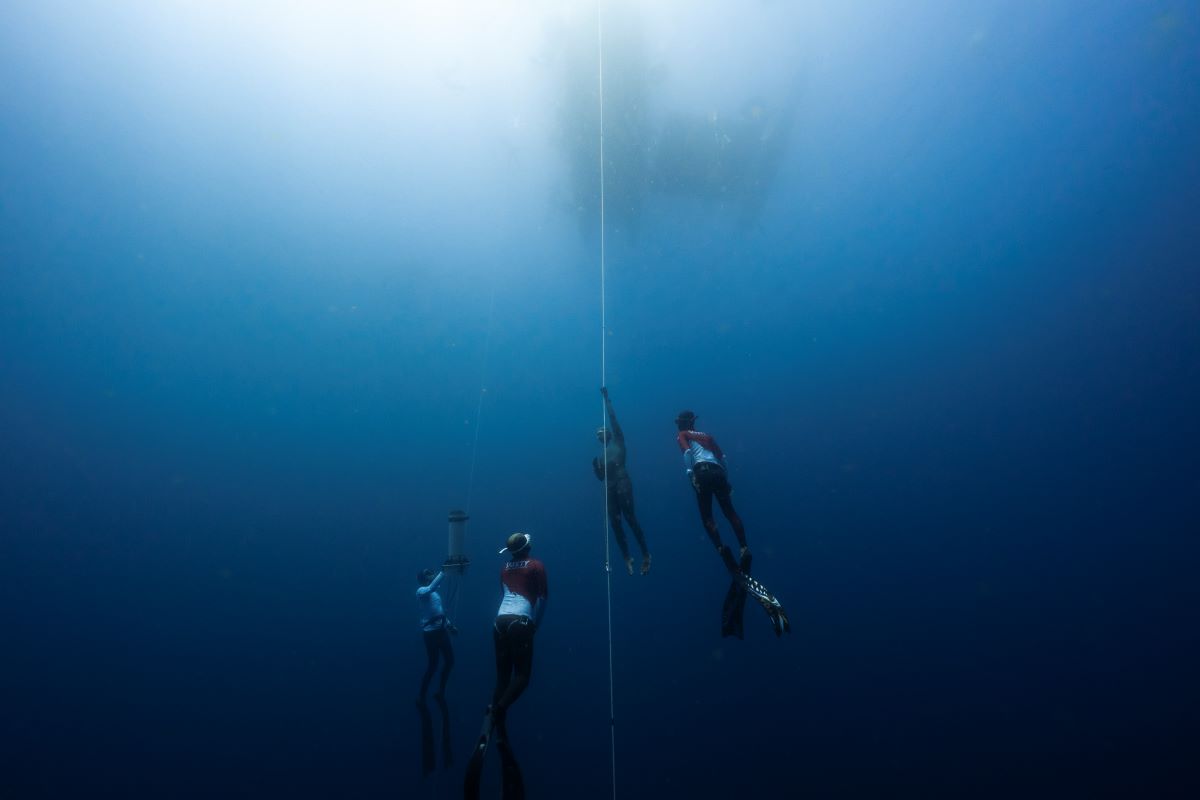
For anyone unfamiliar with competitive freediving, athletes descend and ascend a line to a target depth using one of several disciplines. Some pull themselves down and back up the rope hand over hand. Some use a single monofin. Some use bifins, the two separate fins most people picture when they think of freediving. And some use no fins and no rope at all. The competition runs over three days, with roughly a four hour window each day for every athlete to complete their dive.

In 2025, my job was to capture as much of that four hour window as possible, including the deeper end of the field. The shallower dives that year were still a serious 35 to 40 metres. I chose sidemount on air, which let me go a little deeper for the first few competitors before I had to work my way shallower for the rest of my roughly 150 minutes of total bottom time.
It didn’t go the way I’d hoped. First, I simply couldn’t shoot the whole event. The gas ran out long before the athletes did, so I missed a significant chunk of the competition. Second, there was current, and sidemount in open water with current is miserable. There’s nothing to hold onto, and I spent the dive feeling like a flag being blown around, with no control over it. Sidemount gives you gorgeous trim for penetrating wrecks and caves, but shooting upward toward the surface fights that trim completely. I was arching my back and finning constantly just to hold a useful angle, which left me with a genuinely sore back by the end of each day. And then there were the bubbles. Safety divers meet freedivers right as they start their ascent from depth, timed precisely, which meant I was often working in close proximity to them too. Get too close on open circuit and my bubbles could hit a safety diver at exactly the wrong moment, a real risk to the athlete that I had no intention of taking. Between the current and the need to keep my distance, sidemount turned out to be about the worst possible configuration for this job. The one genuine upside was the extra bottom time I got from carrying that second cylinder rather than a single tank.
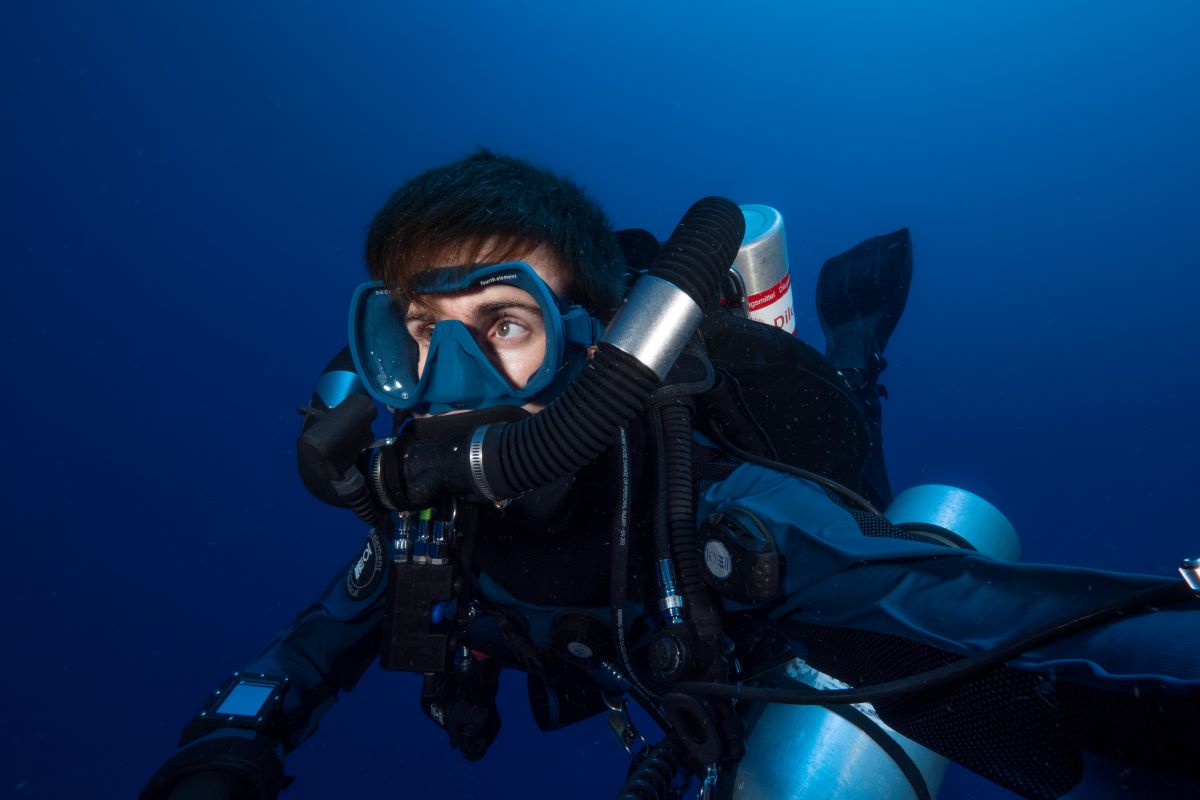
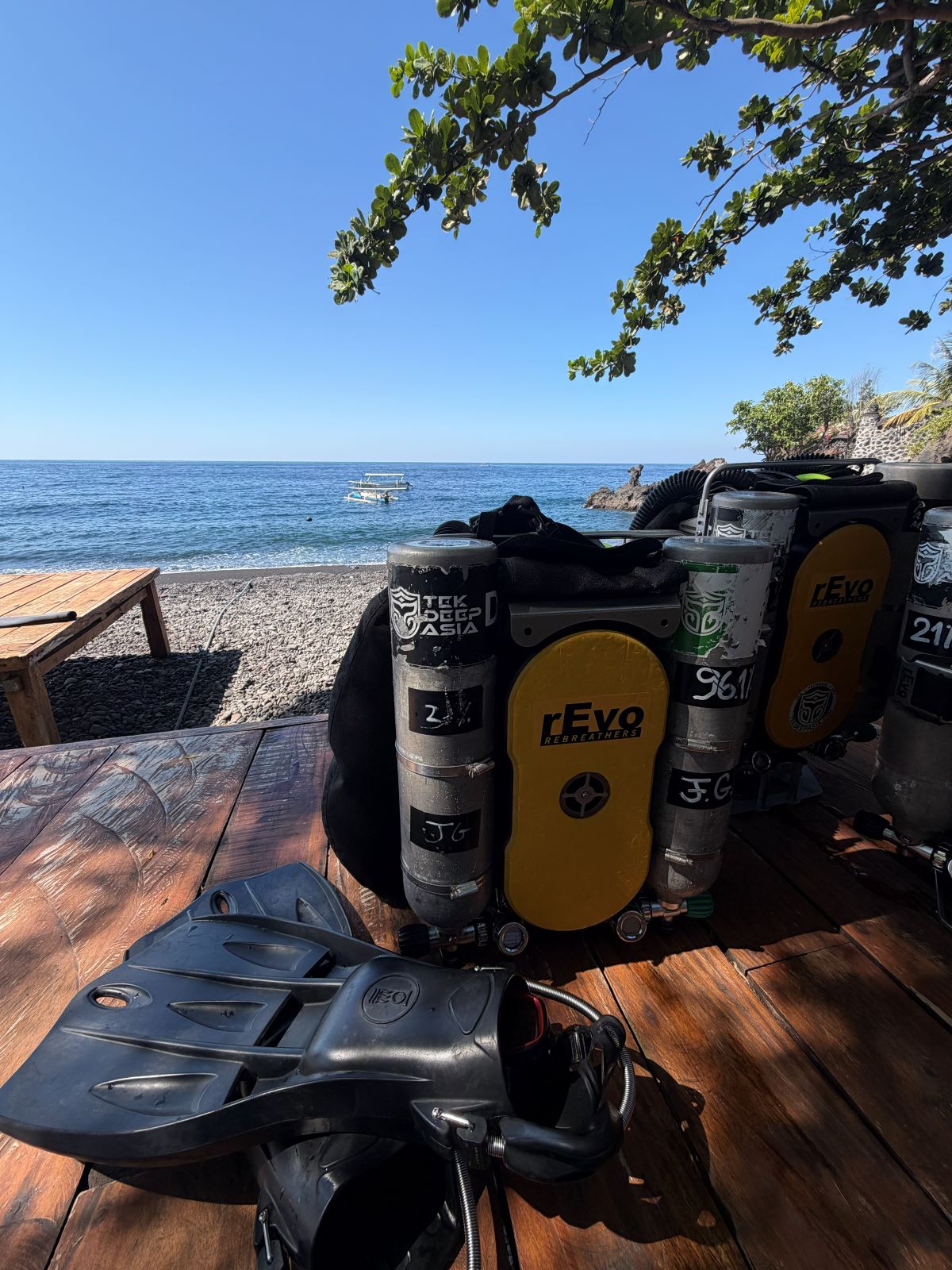
This year, I dived my rEvo rebreather instead, and the entire four hour window, every day, was covered. Across three dives over three days, my total time in the water came to very nearly twelve hours, and I captured every single athlete on both descent and ascent. No deco obligations either. Because the shallower dives fell at the end of the competition this year rather than the start, I planned my profile to hover just above twenty metres for most of the event, which kept things comfortably within safe no stop limits. And no bubbles. I could work right alongside the safety divers without disrupting them in the slightest. Several athletes told me afterwards they hadn’t even realised I was down there. I got in close, got the shots I actually wanted, and stayed streamlined even in current without burning much energy, so I had enough left to stay fresh for the following day’s diving. And because a rebreather doesn’t fight your trim the way sidemount does, I could look upward at the surface without arching my back into knots.
What This Means for the Rest of Us
Not many of us are shooting four hour freediving competitions. But the same qualities that made the rEvo the right call in Manado apply to ordinary reef and wreck photography too. That silence is extraordinary for not spooking marine life. You can get closer to skittish subjects than open circuit ever allows. You’re not clock watching either. How many of us have ended a dive early on gas and missed the exact moment the rest of the group nailed the shot? A rebreather lets you simply stay down. It also uses far less gas than open circuit, which matters increasingly for deep divers as helium prices keep climbing.
As the technology matures, it’s also getting more accessible and easier to fly alongside a camera. Heads up displays in particular mean you can keep your eye on your monitor rather than glancing away to check a handset. The silent world rebreathers open up is a genuinely different way of shooting underwater, and it’s one every serious underwater photographer and videographer should have on their radar.