Sharks Survived the Dinosaurs – But Can They Survive Us?

By Staci-lee Sherwood
Sharks, as a species, have lived on Earth for hundreds of millions of years. They first evolved during the Devonian Period about 380+ million years ago and long before dinosaurs roamed. This period is called ‘the age of fishes’, when a massive and diverse growth of fish species occurred. It’s amazing and tragic to think how a species that has lived and thrived for so long could go extinct all because of one species, we humans. There are about 500 distinct species ranging from the smallest, dwarf lantern shark that measure less than a foot in length, to the whale shark reaching over 40 feet long and the largest shark and fish in the ocean.
Declining populations
If we continue to kill over 100,000,000 sharks a year for their fins, oil, skin and meat or just because we fear them, we will wipe out an amazing apex predator that predates and outlived dinosaurs, but perhaps not us. While some are threatened with extinction, more than half the species we have left are endangered and some critically. It’s up to us to stop the insanity for a species so misunderstood and underappreciated or wipe them out for their body parts. Sharks Angels is a nonprofit that has been fighting to save our sharks for over twenty years through education, grassroots campaigns and legislative action. Jamie Pollack, the executive director, had this to say: “Shark Angels was founded on a bold idea, if people could see sharks the way we do, they’d fight to protect them. Without sharks ocean ecosystems collapse. Without healthy oceans, life on Earth struggles to survive. We’re here to make sure that doesn’t happen. Join us. Save sharks. Protect our blue planet.” Over the years they have pushed to ban shark finning while inspiring future generations to protect sharks and the oceans.
While it’s estimated the global shark population in general has declined by 70%, it’s probably greater than that since estimates are notoriously low-balled. Some species have a population decline of 90%, as do many ray, whale and sea turtle species. This is the ocean dying in plain sight with little being done to stop it. Sharks have been made out to be the bad guy, something to fear… remember the hit movie of the 1970s JAWS? Along with fear, hatred and body parts some shark species suffer from photo ops. During catch and release events many hammerhead sharks die from being out of the water too long while enduring a photo op.
I was on the island of Nantucket when this movie played all summer and no one went into the ocean. Peter Benchley later regretted the fear his movie fanned against sharks and became their advocate saying: “Without sharks, you take away the apex predator of the ocean, and you destroy the entire food chain. We should be afraid of sharks half as much as sharks should be afraid of us.”

My favorite shark, the Hammerhead

As you watch this short video see the beauty. Watch with appreciation and understanding, not fear:
“Turning fear into fascination and passion into action for shark conservation.” – Jamie Pollack
Global exploitation
The global profit from using shark cartilage and squalene is estimated at upwards of $1 billion so few people will turn down that much cash, unless they have integrity. If you think people who work in the makeup and supplement industries somehow have more integrity than those torturing animals in ‘research’ labs you would be sorely mistaken and disgusted. All industries are focused on making a profit, it has nothing to do with a safe, effective quality product. Now that we are in the age of no regulation, oversight or accountability don’t count on anyone making a a product that stands by their advertising unless they are certified and accountable. Many companies used the excuse of trade secrets to cover up using illegal, toxic or controversial ingredients. Following are several examples of exploitation of sharks bringing them to the brink of extinction.
“We are pushing these vital guardians of the ocean to extinction.” – Jamie Pollack
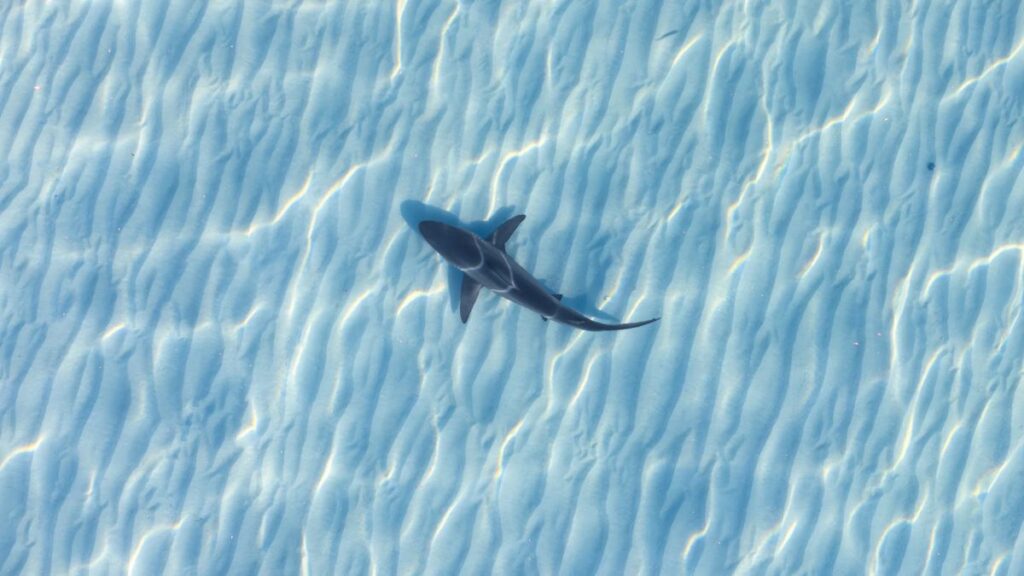
A reef shark glides through the water:
Shark fin soup
This food product has nothing to do with nutrition and everything to do with status, in public. Shark fin soup dates back 1,000 years as a symbol of Chinese aristocracy. Now that China manufactures a huge amount of goods gobbled up by Americans looking for cheap and fast products this economic boom has created a middle class eager to join the ranks of the upper class. Having enough money to spend on shark fin soup in a pricey restaurant is just the ticket. Never mind that over 75,000,000 sharks are killed just for this status symbol or that the cold brutality of slicing off the fins and leaving the sharks to die a slow death is on the rise.
Aside from China these countries also consume this soup: Vietnam, Hong Kong, Indonesia, Singapore, Thailand, Taiwan and Malaysia though I’m sure it’s sold in other countries more quietly. They all have a terrible track record when it comes to conservation and animal welfare. China leads the way for helping to wipe out elephants and rhinos for their tusks and horns while Vietnam tortures bears in cages for years for their bile. Their food markets host every species one can think of, often live and killed on the street for customers. There is little evidence we can expect a slowdown of killing sharks in cultures that support such violence. I personally can’t find much compassion in a culture that promotes this, can you? The countries supplying shark fins include: Indonesia, Spain, India, Mexico, the United States, Argentina, Taiwan, Malaysia, and Brazil. There are more than 100 countries involved in the shark fin trade.
Click here to read more about the trade:
https://pubmed.ncbi.nlm.nih.gov/29077226/
I personally can’t see how any sane person looks at this and thinks it’s OK to do, can you?

Does your makeup, supplements or vaccines have shark parts in them?
Squalene is an oil derived from the shark’s liver. It’s used in many cosmetics from anti-aging creams, sunscreen and aftershave to lipsticks and can also be found as a supplement. The oil is close to what is naturally found in human sebum and is sought after for its rich moisturizing properties. It’s estimated that about 2,500+ sharks are needed to produce 1 ton of squalene. Once the liver is removed most sharks are tossed away like trash since the fishermen only consider their parts to have value, and not the living shark itself. Deep sea sharks have the largest livers and therefore are prized the most. Over 50 species are killed for this and the gulper shark takes the biggest hit, so much so that they could go extinct.

The cosmetics industry calls it ‘liquid gold’. Their drive for profit while playing on the often desperate attempts to look young in a youth-driven culture has pushed many sharks killed for their livers to near extinction. One has to wonder how consumers can justify a shark’s death in a vain attempt to shave off a few years when a healthy diet and lifestyle could do the same. A quick fix rarely works.
It’s never acceptable to kill another living creature in the pursuit of youth.
Truth is cosmetic, health and drug companies hide an overwhelming amount of vital information from consumers. They do this especially when using dangerous toxic ingredients, they also hide those they know full well are controversial and unsustainable. It’s up to consumers to read every label, research ALL claims and be suspicious of every company. Their track records prove they can’t be trusted and often greenwash to cover up their lies. The responsibility to hold these companies accountable falls to the public, the government has failed to do this and has now abdicated its role in protecting its citizens.
Another industry with an abysmal track record for honesty and safety is the drug industry. Vaccines have become very controversial in recent years. Few people know what is actually in them. Squalene is used as a boosting agent and can be found in many of the flu vaccines. Many scientists are working on safe sustainable alternatives from non-animal sources like sugar cane, olive oil and wheat germ. Drug companies claim it’s cheaper to use squalene than to find an alternative. Keep in mind these are the same companies that make billions of dollars selling drugs that have huge dangerous side effects and questionable ingredients, so they hardly have any credibility. During COVID-19 many of them made a record $90 billion so they can afford to look elsewhere for ingredients and let the sharks we have left live free.
Click here to read more about shark oil in vaccines:
Shark cartilage is no cure for cancer
There is no scientific evidence that shark cartilage helps slow or prevent cancer. During a clinical trial in the U.S. patients with lung cancer were divided among those treated with chemotherapy and cartilage and those just receiving the chemo. They found no evidence the cartilage helped. In fact the cartilage can have side effects from constipation to headaches to low blood pressure. It’s a product that sells without any verification it’s real or does anything, so those who profit from the myth still push it on desperate people looking for a miracle cure. The theory that sharks don’t get cancer therefore consuming their cartilage protects those that consume it doesn’t address another obvious flaw. The ocean is so toxic do we really know they’re not getting cancer or other diseases? In a world where your toothpaste has arsenic your beans and produce have lead and your makeup has asbestos, even if the myth of shark cartilage were true you would still get cancer from a long list of poisons the government allows in your food and health products.
Click here to read more about the dangers of using shark cartilage:
The myth continues as long as people make a buck.

A living shark is worth more economically through tourism than a dead one.
How to help
-
Never go shark fishing or hunting
-
Do not engage in catch & release as many sharks die after the photo op
-
Do not eat shark fin soup, it’s not only cruel it has no taste or nutritional value
-
Never buy cosmetics with squalene. Jojoba oil is non toxic and great as a moisturizer
-
Never buy shark cartilage, instead improve your diet and lifestyle
-
Do educate people that sharks are not ‘bad’ or out to kill them and should be appreciated as part of a healthy marine ecosystem
-
Remember ‘Jaws’ was a movie not reality. However if you have open wounds or are menstruating skip the ocean as blood does cause attention. Their sense of smell is greater than ours and the smell draws them on instinct, they’re not coming to kill you and will be greatly disappointed that you’re not a seal or fish
-
Do enjoy the ocean in a safe way and spread the message to protect, not exterminate, our sharks
-
Donate to legitimate shark conservation groups and/or volunteer
-
Click here for more info on shark parts used in commercial products
https://sosfuture.org/blogs/news/how-to-detect-shark-in-our-daily-products
 For more information about sharks and how you can help save them here are two worthy nonprofits working to save our sharks:
https://www.robstewartsharkwaterfoundation.org/
Staci-lee Sherwood
https://www.facebook.com/SoFlo.SeaTurtle.Woman
Lifelong preservationist, environmentalist and animal advocate. Writer, blogger, photographer.