Saving Leatherback Turtles

Last summer I was sat on the cliffs at Pendeen in Cornwall watching the sea swell gently rise and fall over the rocks below. It was a still and bright sunny day with Fulmars circling along the cliff face and the occasional seal checking out the shallows for food. Just as I was thinking how it couldn’t get any better, nature did its thing and sent a giant Leatherback Turtle cruising 100meters out from the shore. It really was a giant too. Hard to guess its real size but it had to be at least 5-6ft long.
The leatherback is the largest of the marine turtles and gets its name from the black, leathery skin that covers its carapace. Leatherback turtles are considered to be critically endangered by the International Union for the Conservation of Nature (IUCN). Nesting females are often killed for their meat and their eggs are harvested. At sea leatherbacks seem to be particularly vulnerable to entanglement in fishing gear, especially long lines and gill nets.
It’s hard to describe how I felt watching this fantastic animal swimming to some unknown part of the ocean. I know I was smiling. It is hard to accept that one day soon, that turtle, along with its entire species, may be gone from this planet forever, never to return.
Larry McKenna is the founding director of S.O.L.O. (Save Our Leatherbacks Operation). I first heard of his work through MilaBooks.com and their Sea-Gram News Letter. The following is taken from the April edition of the Sea-Gram news letter.
Larry McKenna’s work takes him to the remote land of Papua, Indonesia, home to the Aboriginal Papauans, and site of the largest leatherback sea turtle nesting beach, about 18 kilometers long and up to 100 meters wide.
Larry describes the scene on the beach:
“The only illumination is a reflection of moon light on the white foam of a breaking wave. All is quiet, except the gentle lapping of the surf while we wait for a living dinosaur to exit the sea and laboriously climb the slope of the beach.
She will locate where she was hatched 12 or more years ago, repeating the 150-million-year drive to reproduce so the species may survive. Left alone, this ancient hatching process would continue unimpeded, but humans have introduced the spectre of extinction of this most valuable creature of the seas.”
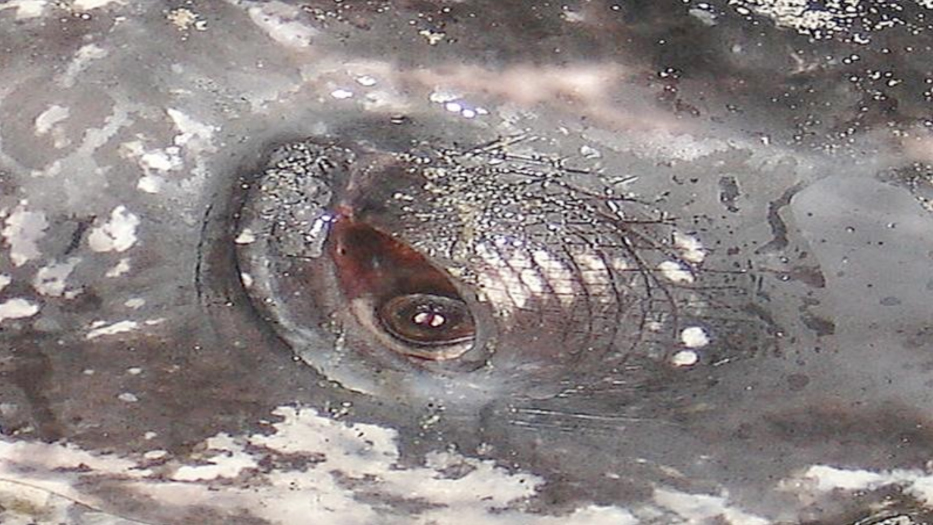
When the leatherback selects her nesting spot and begins to dig a four-foot-deep nest, she goes into a trance and does not recognize any activity. Enlightened humans can approach and marvel at the amazing beauty nature provides.
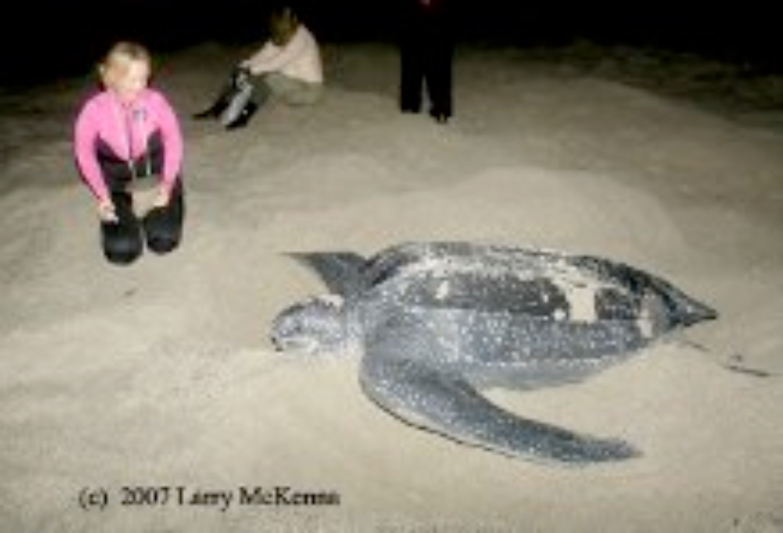
However, while she is in this egg-laying trance, the nesting female is in danger from other humans; those who would slit her throat and use her skin for handbags and fashion items, in addition to senseless killings, egg poaching, and trophy collecting.
Global warming poses another threat, as high tides drown nests and heat cooks the eggs in their shells.
Leatherback hatchlings are about four inches long and cannot crawl over a twig. Yet they must face a host of jungle predators at nesting beaches, such as wild pigs, dogs, salt water crocodiles, crabs, and pythons.
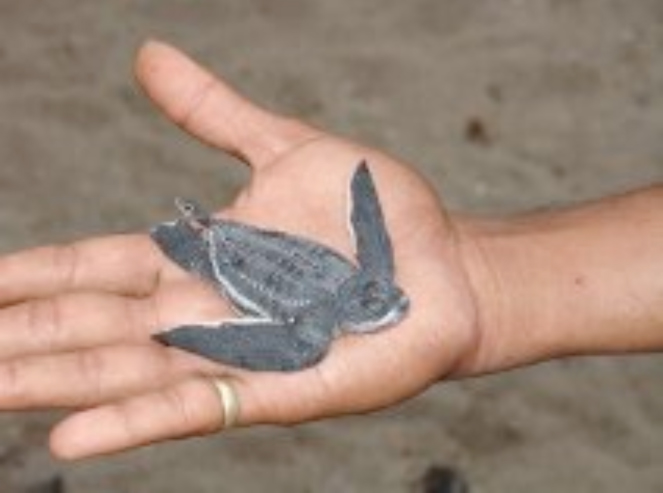
Larry’s activities include relocating eggs from tidal nests into bamboo pens, and excavating the nests that hatched in the night to examine the remains and determine what happened to unhatched eggs.
In almost every nest he finds several comatose hatchlings, which ran out of air climbing upward to freedom. He places an unconscious hatchling in the palm of a guest’s hand and encourage him/her to give it “leatherback CPR” by softly blowing into its face and nose. Soon it begins to wiggle and wants to be set on the sand. All the volunteers have tears in their eyes because they have just given life to a leatherback baby which would have become crab food later in the day.
How you can help:
1. Should you wish to experience this truly exciting and memorable visit to the leatherbacks, along with some of the best diving in the world, please contact P.J. Campagna, a very dedicated foundation volunteer, for the details:
2. Watch this short youtube video (which includes donation information), placing you right there on the nesting beach, but which also shows some of the ATROCITIES humans inflict on these gentle giants:
The above text, information, and photos are used with permission, from Larry’s article: To Touch A Dinosaur.