Ghost Fishing

In a way the term Ghost Fishing almost has a sci-fi/adventure feel to it and does little to portray the great horror and devastation it actually inflicts on the marine environment around the world. The first I ever new about Ghost Fishing was back in the 1980’s when I joined the Sea Shepherd Conservation Society to make a film for UK television about the Drift Net fisheries in the North Pacific for Tuna and salmon. At that time, the combined Japanese and Taiwanese fishing fleets were laying approximately 20,000 miles of drift net at any one time. Each net being up to 30 miles long and 100 feet deep, drifting on the ocean currents catching everything that came in their path.
As well as the targeted catch of Tuna, the bi-catch was of unimaginable quantities. Everything perished – Whales, Dolphins, Turtles, Seals, Sea Birds, Sharks and many species of pelagic fish.
Many of these nets were lost at sea and continue to ‘fish’ until the shear weight of the catch would drag them to the sea bed. But this was not the end of the nets’ fishing life. On the sea bottom the nets continue to entangle marine life until one day the ‘catch’ would decompose enough to allow the nets to once again rise to the surface and begin the whole process over again.
Those nets are still out there. It is not just mono-filament nets that cause ‘Ghost Fishing’ problems. Any lost or discarded fishing tackle will take its toll. The problem continues.
There is a Dutch group who are trying to tackle the problem. The article below is written by Pascal van Erp, one of the directors of www.ghostfishing.org
Ghost Fishing is what fishing gear does when it has been lost, dumped or abandoned. Imagine a fishing net that gets snagged on a reef or a wreck and gets detached from the fishing vessel. Nets, long lines, fish traps or any man made contraptions designed to catch fish or marine organisms are considered capable of ghost fishing when unattended, and without anyone profiting from the catches, they are affecting already depleted commercial fish stocks. Caught fish die and in turn attract scavengers which will get caught in that same net, thus creating a vicious circle.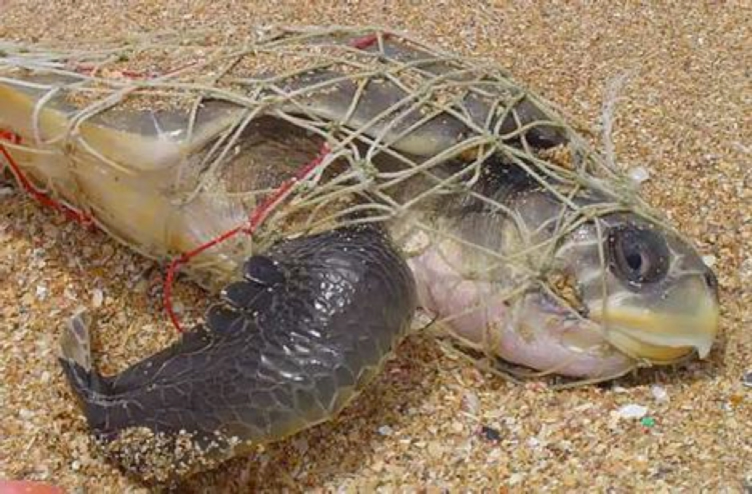
Ghost nets are among the greatest killers in our oceans, and not only because of their numbers. Literally hundreds of kilometers of nets get lost every year and due to the nature of the materials used to produce these nets, they can and will keep fishing for multiple decades, possibly even for several centuries.
When caught on a reef, nets do not only catch fish, turtles, crustaceans, birds or marine mammals, they also destroy hard and soft corals, wiping out complete ecosystems while swaying in the current. If caught on wrecks nets can suffocate a wreck and thereby render hiding places for marine life useless, or even trap them inside.
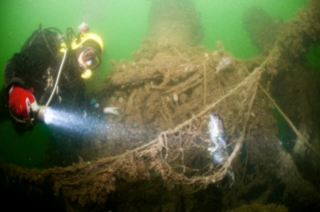 Divers are all too familiar with this phenomenon, especially in well fished areas. The founders of Ghost Fishing were confronted with ghost nets while diving the many wrecks in the Dutch North Sea. In 2009 they joined a local team of divers who started to clean those wrecks. After some years of local efforts it was time to broaden the horizon and get in touch with like-minded groups all over the world. And so the Ghost Fishing foundation was born. As of March 2013, Ghost Fishing is collaborating with 14 teams worldwide to work on existing projects, set-up new ones and document these through visual media, educating divers, informing a wide audience and raising social awareness. The Foundation exchanges solutions and best practices and maintains a steady stream of information through social media, and a website that offers extensive information and possibilities for interaction.
Collecting ghost nets is also part of a broader mission in which The Foundation works towards sustainable recycling of the nets, which will be used as raw material for new products.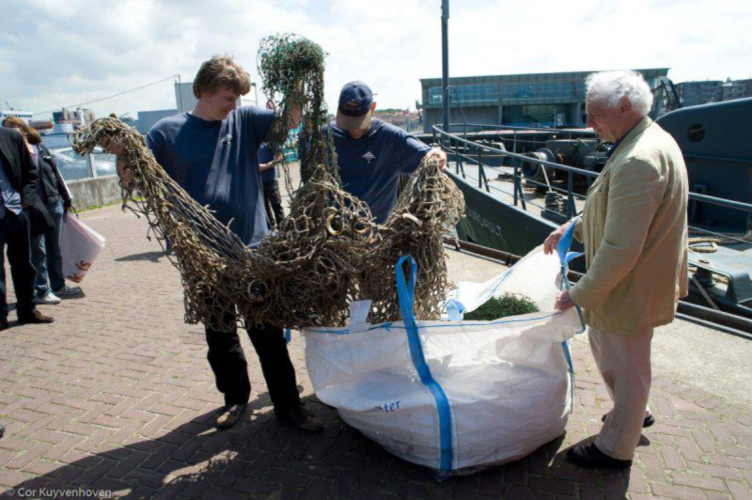
The Ghost Fishing Foundation was started as a non-profit organization in November 2012 and has already presented itself at the Hylkesukelus 2013, a wreck diving seminar in Helsinki, Finland and Duikvaker 2013 in the Netherlands where the message was well received and many valuable contacts were made. The next event will be Baltictech Conference 2013 in Poland where the most recent material of our work will be shown.
In 2013 we hope to participate in clean-up work in Krnica, Croatia, Portofino, Italy and if funding permits more plans will be set-up and executed.
As marine debris is rapidly becoming a greater problem, it is imperative to take real action as soon as possible. Ghost Fishing intends to collect funds to finance clean-ups, to sponsor gear, to train divers and to raise public awareness.
If you would like to know more or start your own project visit http://www.ghostfishing.org/