Future Focus: Owen Sanders

In each instalment of Future Focus, we speak with past and present students of the Marine & Natural History Photography BA(Hons) course at Falmouth University about their experiences, challenges, and successes on the course.
 Owen Sanders – Student
(2nd year Marine and Natural History Photography 2025)
Gina: What were you doing before coming to Falmouth University and how did you find out about this degree?
Owen: Before coming to university, I was working as a climbing instructor and spent most of my time outside either climbing or diving. I had known about the course for a while as my brother is an alumni.
Gina: Was there a particular part of the course that piqued your interest?
Owen: For me the part of the course that piqued my interest was the diving modules. Having the opportunity to dive and take photos as part of a degree was very interesting to me.
Gina: Did you have any underwater photography experience before joining?
Owen: I had been diving for a couple years before coming to university and managed to get a little bit of hands-on experience with a camera underwater during the summer before I started.
Gina: What were your expectations from the underwater photography module?
Owen: Before starting my first year, I had heard about the amount of different kit the dive team have for the students to use. I went in quite excited to use all the different bits of kit and was not disappointed.

Gina: So, you successfully joined the course. Were you apprehensive about anything initially?
Owen: At the start of my first year, I was unsure how the dive module would run and what was expected of us.
Gina: Did you learn to dive specifically for the course?
Owen: I learnt to dive when I was 16 and spent the recent years diving with my family. It wasn’t until I decided Falmouth was for me that I did my PADI Rescue course.

Gina: How was your first cold-water dive?
Owen: I have only ever dived in the UK so every dive is a little chilly. My first dive with the dive team was a simple and easy dive. All we had to do was explore the area.
Gina: Did Falmouth support you adequately for that dive?
Owen: Yes, absolutely. From the support in and out the water, the dive felt very calm and simple.

Gina: Describe a typical week as an underwater photography student.
Owen: A typical week for me is I have lectures Monday and Tuesday. During these days I’ll get on with my module work and plan photoshoots. From Wednesday – Friday these are my dive days where I dive with the university. I’ll be diving one of these days and will generally keep the other two clear for any spaces that open for me to do another dive. Generally, I aim to get in the water by myself at least once a week if the weather allows.
Gina: Did lectures effectively prepare you?
Owen: Yes, straight from the start of term we had talks and meetings about how the dives work and what’s expected from us. The dive team broke everything down to make it as simple for us as possible.

Gina: How are dives organized?
Owen: On a Monday the dive team will put out a list of everyone’s names and what time slot they have on which day. If there are empty spaces people can take them on a first come first serve basis. There are two dives a day Wednesday – Friday. So, this means if you’re quick you can sometimes dive twice a week.
Gina: What did you enjoy most about the underwater photography course?
Owen: I enjoy the amount of kit there is for us to use. Whatever idea we have there is a way for us to do it with the kit in the dive stores.

Gina: What does a typical dive day look like?
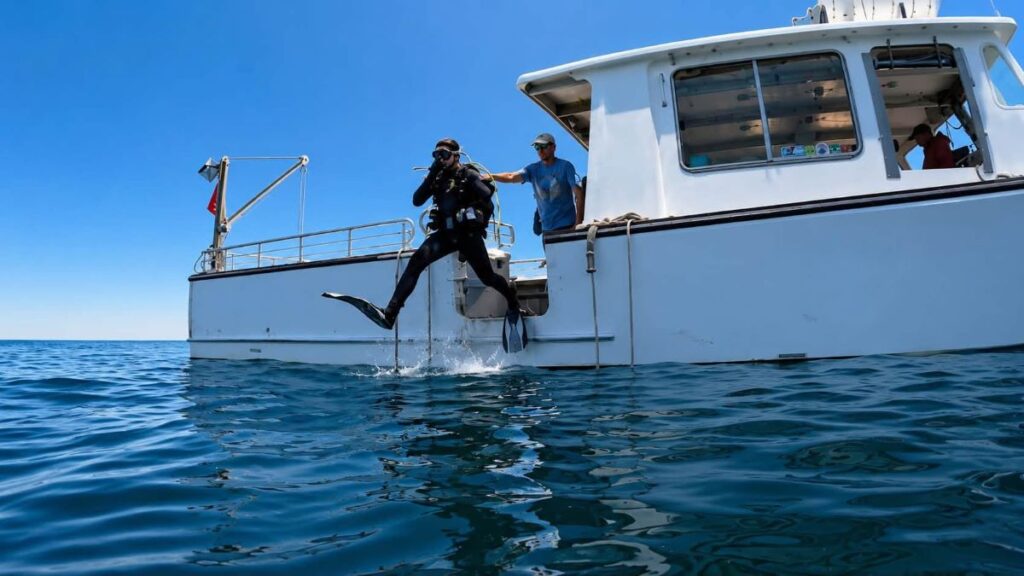
Owen: A typical dive day for me begins the night before. I will head to the dive stores and prepare my camera for my dive. This includes sealing and testing it is watertight. On the day of the dive my routine is to turn up to the dive site a little early. This way I can chill out for a bit and have something to eat. When our dive starts, we get kitted up, have a briefing on the dive and then also on the cameras before checking our buddies and having a good dive.
Gina: Describe the dive team at Falmouth.
Owen: The dive team at Falmouth are always willing to listen and help me with any questions or ideas I have. They’re always cheerful and fun to be around.

Gina: How much has your work improved since starting?
Owen: Since I started at Falmouth, I have been able to understand underwater photography so much more. My work has gone from blurry photos full of backscatter to images that I am proud of.
Gina: What’s your proudest achievement?
Owen: My proudest achievement is from this year. I received the best UK entry award in CEWE’s Photo Awards in the Young Talent category.
Gina: Do you feel prepared for a career in underwater photography?
Owen: I think that when I leave university, I could start a career in underwater photography. The amount I’ve already learnt so far makes me feel like I could start now.

Gina: Advice for prospective students?
Owen: My advice would be to do your dive training and get in the sea, even if it’s just for a swim or snorkel.
Gina: Any advice for current students?
Owen: Get in the water and experiment.
Gina: Would you choose this degree again?
Owen: Absolutely. I always thought that university wasn’t for me. Until I found this course.
Click below for more details about Falmouth University’s Marine & Natural History Photography course:
https://www.falmouth.ac.uk/study/undergraduate/marine-natural-history-photography
Meet Gina Goodman and the rest of the team at Falmouth University shaping the next generation of underwater photographers here.