Beyond the Blue: Still Finding the Unexpected

What makes a strong Red Sea macro photograph
Once you start to see macro life in the Red Sea, the next step is learning how to photograph it in a way that actually works.
Most of what I shoot is small. Nudibranchs, shrimps, gobies, the occasional frogfish or seahorse. Often just a few centimetres across, sometimes much less. That scale immediately changes how you approach a dive, not just in how you look, but in how you plan and what you carry.
Macro photography is always a balance between preparation and compromise. You are making decisions before you even enter the water: which lens to take, whether to add a wet diopter, whether a snoot might be useful, how much weight you are willing to carry. None of it is particularly light or convenient, and it is rarely possible to cover every eventuality on a trip, let alone a specific dive.
I remember diving the Ulysses wreck in the Northern Red Sea last year. It was an obvious lens choice, an 8mm fisheye. I missed the chance to photograph a cluster of beautiful flabellinas on the stern. They ended up being the highlight of the dive for me, but I had only heard about them in the briefing, too late to change lenses.
That is where more compact systems really come into their own. Cameras like the Olympus TG series are hard to beat in this environment. They offer excellent macro capability straight out of the box, can be paired with wet lenses when needed, and remain small enough to get into tight spaces that larger setups simply cannot reach. They are also far more forgiving when it comes to travel, both in terms of weight and practicality. In many ways, they are the perfect compromise for Red Sea macro.
The ability to revisit a site makes just as much of a difference as the equipment you carry. Unlimited, independent shore diving allows you to return with a different setup, a clearer plan, and a better understanding of the subject. You are not relying on a single opportunity, which makes a noticeable difference to both your approach and your results.
Recently we have also returned to doing night dives on the house reef, which has added another dimension entirely. On the first night dive of the season, we recorded 15 different species of nudibranch, many of them in multiples. Since then, I have been back to the same area almost every night, adjusting my setup and refining my approach.
Night diving brings its own challenges. You are more limited on time, more reliant on your torch and your buddy, and working in an environment where visibility is defined by your light. Many critters emerge at night but are far more skittish, often retreating just as you begin to line up a shot. Add other divers, moving beams and the constant battle with backscatter, and everything becomes more deliberate.

Even with the right setup, there is still the question of what you are trying to achieve with the image. For me, nudibranchs tend to fall into two distinct categories. There are the larger, more colourful species, the ones that are immediately striking. With those, I will usually stop and spend time, even if they are common, because there is always the potential to create something visually pleasing.
Then there are the very small ones. With those, the goal is often different. I want a photograph that allows me to identify the species later. That might mean prioritising clarity over composition and accepting that the result is more functional than artistic. There is still a huge sense of satisfaction in that, particularly when it involves capturing something that is barely visible, even when pointed out.
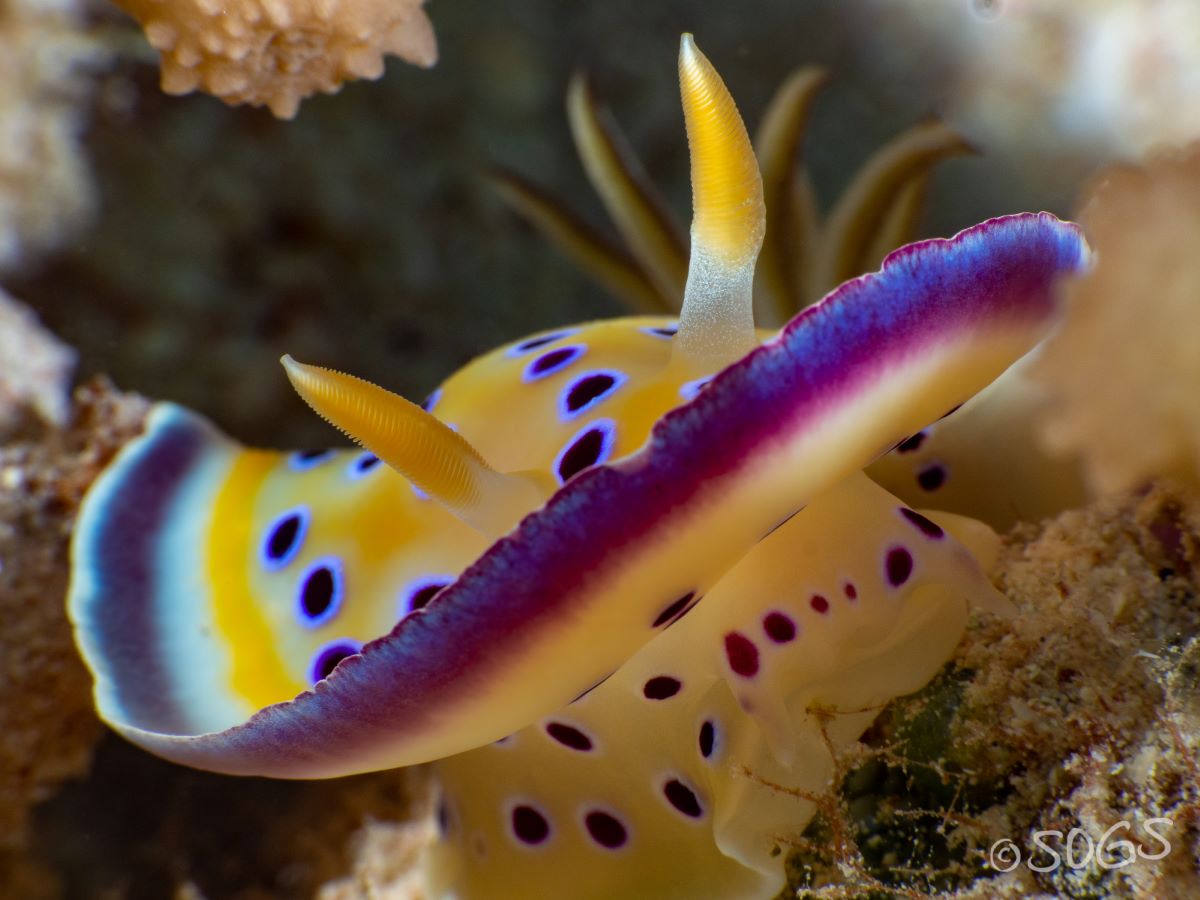
That distinction became particularly clear during a recent sea slug census in Dahab. We had to keep reminding ourselves to take identification shots as well as images for our own collection. It is easy to focus on the more photogenic subjects and overlook the rest, but for documentation, everything matters.
It is also important to recognise that not every subject will translate into a strong image.
At Marsa Nakari, seamoths are relatively common on the shallow sandy floor. They are also notoriously difficult to photograph. Small, subtle and almost perfectly matched to their surroundings, they do not immediately lend themselves to striking images. You can spend a long time trying to isolate them, adjusting your angle and looking for separation from the background. Sometimes, the right decision is simply to move on. The person viewing the photograph will not know how difficult it was to find or how carefully it was approached. They will only see the result. Difficulty alone does not make an image interesting. What tends to work well in the Red Sea is not necessarily rarity, but clarity and intent.
Behaviour can elevate an image. A nudibranch feeding, a shrimp interacting with its host, a goby positioned in a way that gives it presence. Sometimes it is not behaviour but camouflage that draws you in, not just colour, beige on beige, but structure and intricacy, a pygmy pipehorse wrapped around a rope or blending into seagrass. These are the kinds of details that can provoke a reaction or feeling, whatever that might be, in the viewer, even if the subject itself is relatively common.

Composition plays an equally important role. Clean backgrounds are not always easy to find, so small adjustments in position can make a significant difference. A slight change in angle can remove distractions, introduce negative space, or allow light to fall more effectively across the subject. Some subjects require a different approach altogether. Translucent animals, such as melibes, do not rely on colour or contrast, so photographing them becomes more about controlling light and showing structure without overwhelming the subject.
The Red Sea will always be known for its wide-angle potential and there is nothing wrong with that. Its reefs, wrecks and pelagics are what most people come for. But there is another way to photograph it, one that is slower, more deliberate and often less predictable.
It does not always give you what you expect, and you will not always have the right setup at the right time. But when it does come together, it feels considered rather than opportunistic. And that is what keeps it interesting.