Future Focus: Sophie Shields

In each instalment of Future Focus, we speak with past and present students of the Marine & Natural History Photography BA(Hons) course at Falmouth University about their experiences, challenges, and successes on the course.
 Sophie Shields – Student
Gina: What first attracted you to the Marine & Natural History Photography course at Falmouth?
Sophie: I had always been artistic and my art teacher at school persuaded me to take photography at A level, having never really picked up a camera before, and soon there was no stopping me. Having always been a water baby, I was excited to find a course that combined both my interests.
Gina: How did the course align with your expectations when you first started?
Sophie: We were taught the theory, learned about the photographic equipment and all the safety requirements before diving. I had not had an opportunity to try underwater photography prior to starting on the course, so there was much to learn.
Gina: Was there a part of the course that surprised you, either in a positive or challenging way?
Sophie: I was genuinely surprised at how approachable, friendly and encouraging the dive team and lecturers were. They helped me turn some of my more experimental ideas into a reality with their practical experience and extensive knowledge of equipment. With weather often adversely affecting planned dives, I was also amazed at how it is possible to take great underwater photographs in rock pools.
Gina: Can you describe a typical week as a student on this course, both in and out of the water?
Sophie: There is not really a typical week. I am doing the BA Marine and Natural History Photography (with placement) course which means that I will spend the next academic year, my third year, gaining practical experience and not on campus. In second year, around half my week was on campus with lectures, seminars and research sessions in the library, but life on the course for me was heavily dependent on the weather and maximising the opportunities to dive with a camera, when the weather permitted. Socially, beach nights with friends are always a highlight.

Gina: How have your photography skills developed since starting the degree?
Sophie: I had no underwater photography experience prior to starting the course but I quickly learned how to apply and adapt my general photography knowledge to this environment. I enjoy storytelling through my work and also being experimental.
Diving in the UK
Gina: How did you find transitioning to diving in UK waters, especially if you had only dived abroad before?
Sophie: I qualified as an Open Water Diver when I was 10 on holiday in Greece and then when I was 12, I became a Junior Advanced Open Water Diver. Apart from that, all my other diving was in UK waters so the transitioning for me was not too challenging.
Gina: What was your first cold-water dive experience like?
Sophie: I was amazed and excited by the quantity and variety of marine life that I saw on my first cold-water dive. For me this was far more memorable than the cold!
Gina: What’s the most memorable UK dive you’ve had during your time on the course?
Sophie: As part of my placement year, I have been working at Porthkerris and I was fortunate enough to assist a dive team filming for The One Show about the boom in octopus this year in UK waters. I learned a great deal about how a professional film crew work and about underwater operations. It was fascinating.


Gina: Has diving in the UK changed the way you think about local marine life and conservation?
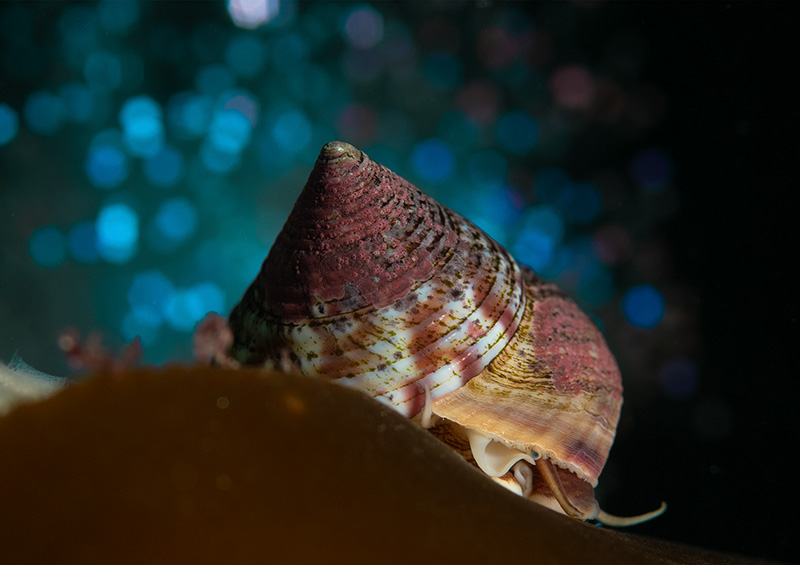
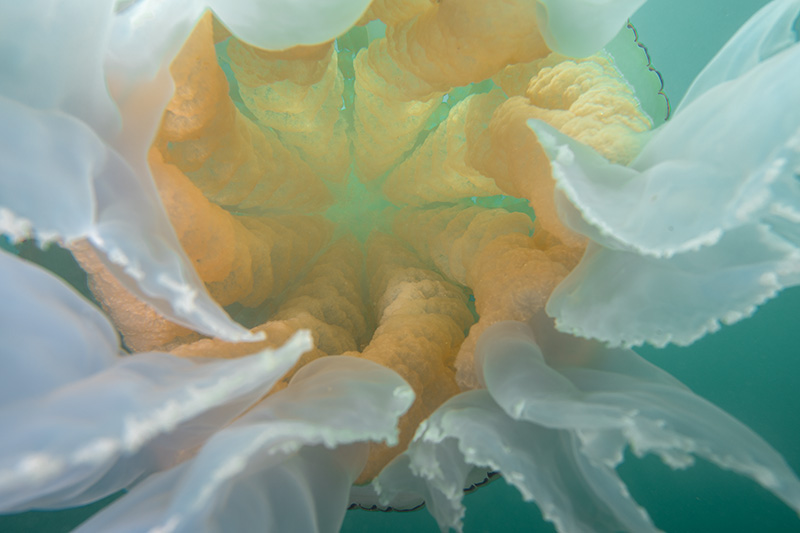
Sophie: Diving in the UK has made me appreciate the small marine creatures like the blue rayed limpet just as much as the larger ones like the barrel jellyfish. In terms of conservation, in my second year I was fortunate to be permitted to film the work of the conservation charity Fathoms Free for my film module and this opened my eyes to the devastation caused by ghost nets.
Marine Life & Projects
Gina: Have you had a favourite species encounter while diving in the UK?
Sophie: It has to be octopus. This summer at Porthkerris where I have been working, it was described as ‘octopus central’ with so many of these intelligent and curious creatures. It was a privilege to observe their behaviour on a daily basis and see how they interacted with the camera.
Gina: What has been the most surprising or unusual marine life you’ve photographed here?
Sophie: That is a tricky question, but I would say that it has to be a mother octopus with her eggs clearly visible and photographically recording the changes in both the eggs and the mother, over time.


Gina: Which project or assignment has been the most rewarding for you so far?
Sophie: Through my work over the summer as part of my placement year, I have been given the opportunity to travel from Porthkerris Divers, Cornwall to Puffin Dive Centre in Oban, Scotland with a colleague and friend, visiting many dive centres throughout the UK culminating in undertaking the HSE Scuba Course. Without a doubt this be enormously rewarding and I will learn a great deal from the experience.
Gina: How do you approach storytelling in your underwater photography?
Sophie: I firmly believe that to be a good storyteller, you have to understand and respect the subject, and this takes time and patience.
Teaching & Support
Gina: How have the teaching team and dive team supported your development?
Sophie: The teaching and dive teams have given me encouragement, shared their extensive experience and knowledge with me and have always been willing to listen to my ideas and help make them a reality.
Gina: Do you feel the course has prepared you for working professionally as an underwater photographer?
Sophie: Undoubtedly! This summer working with several film crews plus independent photographers has assured me of this. My placement year as part of my degree course allows me to experience a variety of aspects of life working as a professional photographer.


Gina: What role has feedback and peer support played in shaping your work?
Sophie: I find it informative to look at the work of peers and chat through their ideas and motivation behind their images; it is a good learning experience. In return, it is helpful to hear their thoughts on my work and to understand their perspective. I do however think that when you are developing an idea, especially if it is experimental, that you must keep focused and strive to make reality the vision that you have.
Personal Growth
Gina: What’s been your proudest achievement on the course so far?
Sophie: During my first term in second year, I developed an underwater fibre optic torch that I used to backlight subjects. I used inexpensive materials and tested it in a bucket of water in my bathroom! By using the torch in different ways and applying coloured gels and cut outs, I turned subjects that are often considered to be boring, into stars.
Gina: How has the course changed the way you approach diving and photography?
Sophie: My general approach to diving and photography has not changed significantly since joining the course but it has made me more aware of issues to think about and has given me the skills necessary to continually improve. I consider that photography gives me the opportunity to share with others what I see underwater; a way for those who cannot dive to access a hidden world.


Gina: Have you developed any particular style or technical focus since joining?
Sophie: I like to take advantage of the exceptional range of photographic equipment that is available for me to use, from the department’s dive store. I vary the type of work that I carry out depending on the water conditions and the marine life at the location. I appreciate that this is a privilege and allows me to develop all aspects of my photography although I particularly enjoy conservation story telling work.
Gina: What skills outside of photography (like dive planning, teamwork, or fieldwork) have you gained?
Sophie: I have learned many administrative and organisational skills from the course outside of photography. My research skills have also improved.
Looking Ahead
Gina: How do you see this degree helping you in your future career?
Sophie: This degree is widely known and enormously respected in the dive and underwater photography worlds. It is seen as a gold standard in the industry. Having this degree together with a strong portfolio, work experience and determination, will certainly help my future career.
Gina: What advice would you give to new students thinking about joining the course?

Sophie: New students should be certain that they are passionate about underwater and wildlife photography. They need to be self-motivated and be prepared to work hard. They should also try to get as much diving experience as possible before they start the course, so that they can get the most out of their time in the water with a camera, when they start.
Gina: What would you say to divers who might underestimate UK waters as a photographic subject?
Sophie: As I will shortly be embarking on a trip visiting many dive sites between Cornwall and Oban, Scotland I would say follow me on Instagram and see if I can change your mind.
Contact Details
Find Sophie on Instagram: https://www.instagram.com/the.blind_photographer/
A message from Sophie:
“I was delighted to learn that two of my Porthkerris octopus shots have just been shortlisted in the Water Life (here) and Macro (here) categories of The British Photography Awards, so if anyone would like to vote for me in the People’s Choice Category, I should be most grateful.”
Click below for more details about Falmouth University’s Marine & Natural History Photography course:
https://www.falmouth.ac.uk/study/undergraduate/marine-natural-history-photography
Meet Gina Goodman and the rest of the team at Falmouth University shaping the next generation of underwater photographers here.